For some students, O-Level Mathematics does not become difficult all at once.
It starts with small gaps.
Algebra steps become harder to follow. Word problems take longer to understand. Graph questions need more careful reading. Geometry and trigonometry questions require clearer working. Then, as Sec 3 and Sec 4 topics build on one another, the marks may start to drop even when the student is still practising.
This can be frustrating because the problem is not always obvious.
A student may know the formula, but not know when to use it. They may understand the lesson in school, but struggle when the question is worded differently. They may practise many questions, but keep losing marks because of skipped steps, careless mistakes, or weak checking habits.
For students taking both E Math and A Math, the pressure can feel even heavier. E Math requires accuracy, clear working, and strong problem-solving habits. A Math often requires deeper algebraic thinking, longer methods, and more confidence with abstract concepts.
That is why choosing O Level Mathematics tuition should not only be about doing more worksheets.
A better starting point is to understand where the marks are being lost. Is the issue weak foundation, careless mistakes, unclear working, poor problem-solving, exam pacing, or difficulty managing both E Math and A Math?
Once the pattern is clearer, the support becomes more targeted. Good O Level Mathematics tuition should help students strengthen their methods, correct repeated mistakes, and approach exam questions with more confidence.
What Kind of O-Level Math Support Does Your Child Need?
When parents search for O Level Mathematics tuition in Singapore, they may be looking for different types of Math support.
Some parents mean E Math tuition. Some are looking for A Math tuition. Some need help for both. Others may not be sure yet — they only know that their child is losing marks, struggling with questions, or becoming less confident in Math.
That is why it helps to understand the type of support your child may actually need.
| Type of Support | What It Usually Means |
|---|---|
| E Math tuition | Support for core O-Level Mathematics skills such as algebra, geometry, graphs, trigonometry, statistics, probability, and problem-solving. |
| A Math tuition | Support for Additional Mathematics topics such as advanced algebra, functions, calculus, trigonometry, and more complex application questions. |
| E Math and A Math support | Help for students taking both subjects who need to manage different question styles, revision demands, and exam expectations. |
| Exam revision support | Timed practice, error review, method marks, accuracy, and paper strategy. |
| Careless mistake support | Helping students identify repeated mistake patterns, improve checking habits, and show working more clearly. |
This distinction matters because Math struggles can look similar from the outside.
A student may say, “I don’t understand Math,” but that can mean many different things. They may have weak algebra foundation. They may understand the lesson but skip working steps. They may know the formula but choose the wrong method. They may make repeated sign errors, misread graphs, or struggle to turn word problems into equations.
So before choosing tuition, parents should ask:
Is my child struggling with the content, the method, the accuracy, or the exam pressure?
Once the pattern is clearer, the support becomes more targeted. A student who is weak in E Math foundations may need a different plan from a student struggling with A Math concepts, or a student who mainly needs timed practice and error review before prelims.
E Math vs A Math: Why the Difference Matters
One common reason parents feel unsure about Math tuition is that “O-Level Math” can mean different things.
Some students take E Math only. Some take both E Math and A Math. Some may be doing well enough in E Math, but feel completely lost in A Math. Others may cope with A Math, but still lose marks in E Math because of careless mistakes, weak problem-solving habits, or unclear working.
That is why E Math and A Math should not be treated as the same subject.
| Subject | What It Usually Tests | Support Students May Need |
|---|---|---|
| E Math | Core Math skills, problem-solving, geometry, graphs, statistics, probability, and real-world application. | Foundation, accuracy, working steps, exam confidence, and problem-solving habits. |
| A Math | More advanced algebra, calculus, trigonometry, functions, and abstract problem-solving. | Deeper concept understanding, method fluency, application practice, and confidence with harder questions. |
- E Math usually requires students to be accurate and organised across many question types. A student may understand the topic, but still lose marks if the working is unclear, the diagram is read too quickly, or the final answer is not checked properly.
- A Math often requires stronger algebraic thinking and more comfort with longer methods. Students may need to recognise patterns, connect concepts, and apply methods even when the question does not look exactly like the example they practised.
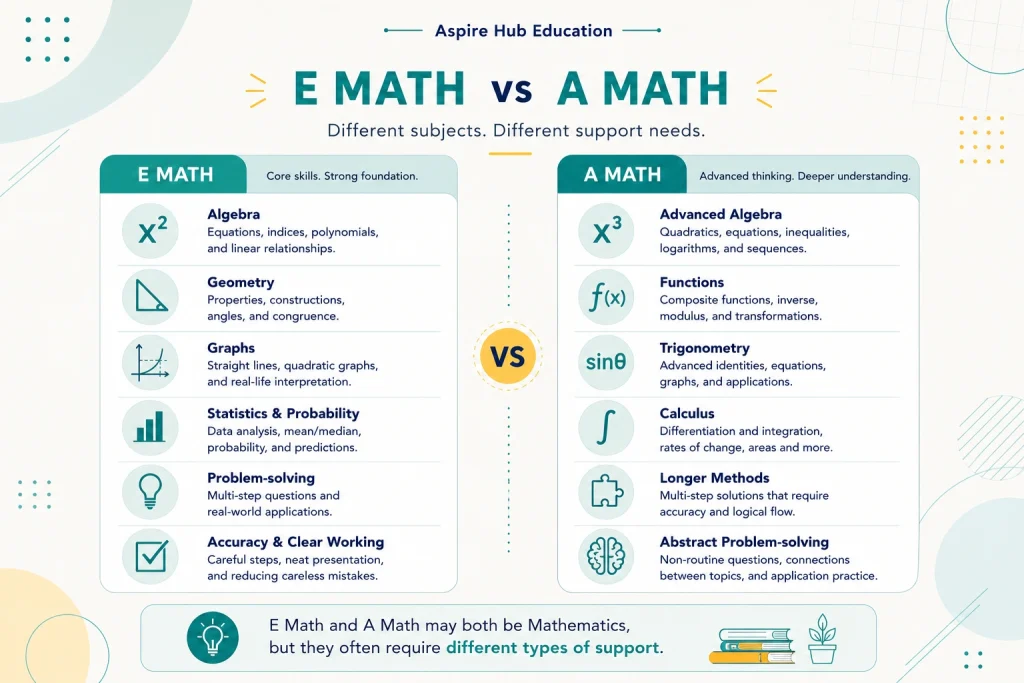
For students taking both subjects, the challenge is not only the amount of content. It is also the difference in thinking style.
E Math often tests whether students can apply core skills carefully and accurately. A Math often tests whether students can handle more abstract methods with confidence. If parents understand this difference, it becomes easier to see whether the child needs help with foundation, accuracy, advanced concepts, or exam practice.
Before choosing tuition, parents should check whether the child is struggling with E Math, A Math, or both — because the right support should match the subject, not just the word “Math”.
Where Students Usually Lose Marks in O-Level Mathematics
In O-Level Mathematics, marks are not lost only because a student does not understand the topic.
Very often, the answer starts correctly — but one step goes wrong along the way.
A negative sign is missed.
An equation is rearranged incorrectly.
A graph scale is read too quickly.
A formula is used without checking the information given.
A word problem is not translated properly into an equation.
This is why O-Level Math can be frustrating. A student may understand the lesson, but the marks do not show it because the method is not accurate or complete enough.
| Where Marks Are Lost | What Usually Happens |
|---|---|
| Algebra manipulation | Wrong signs, expansion, factorisation, indices, rearranging equations, or simplifying expressions incorrectly. |
| Graphs and functions | Misreading scales, plotting inaccurately, misunderstanding gradients, or failing to connect the equation to the graph. |
| Geometry and mensuration | Missing properties, using the wrong formula, reading diagrams too quickly, or not showing enough working. |
| Trigonometry | Choosing the wrong ratio, angle, identity, or not checking whether the answer makes sense. |
| Statistics and probability | Misreading data, choosing the wrong method, or setting up probability questions incorrectly. |
| Word problems | Struggling to translate information into equations, diagrams, or step-by-step methods. |
| Careless mistakes | Calculator errors, skipped steps, wrong units, poor checking habits, or rushing under time pressure. |
These mistakes may look small, but they can cost marks across many questions.
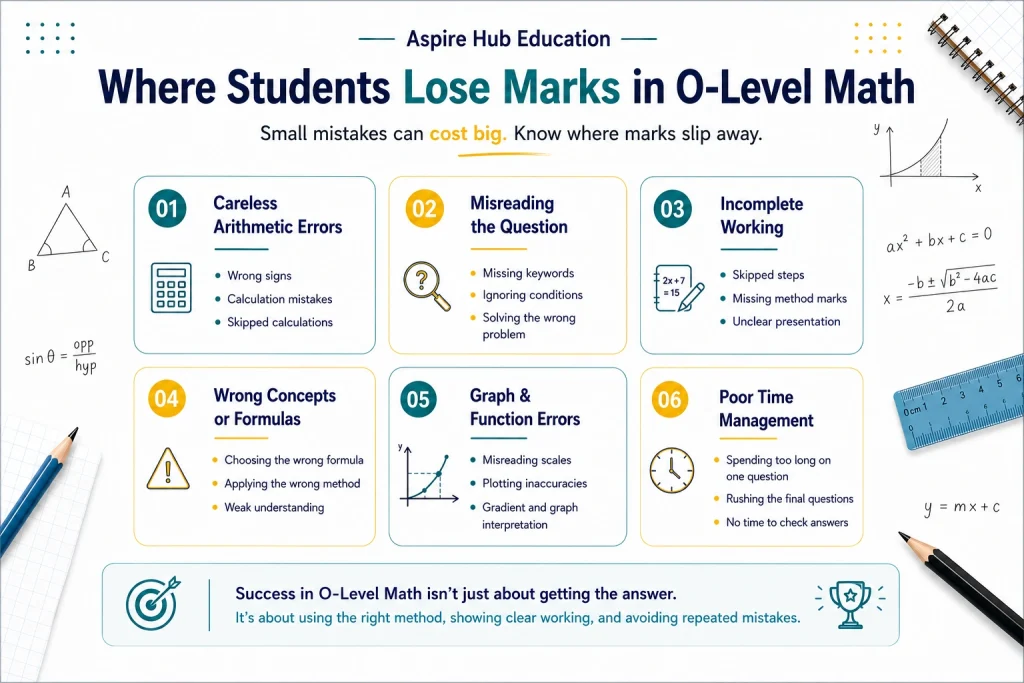
For example, a student may know the algebra method but lose marks because the signs are inconsistent. Another student may understand trigonometry but choose the wrong angle because the diagram was not marked carefully. A student may remember the mensuration formula but use the wrong dimension or forget to check the unit.
That is why Math improvement is not always about doing harder questions.
Sometimes, the bigger improvement comes from making the student’s method more reliable. They need to know how to show working clearly, check each step, and recognise the mistake patterns that keep appearing across different topics..
Why More Practice Does Not Always Improve Math Marks
Many students are told to practise more when their Math results are weak.
Practice is important, but more practice does not always mean better marks — especially if the student keeps repeating the same mistakes.
A student can complete many worksheets and still make little progress if they are only copying solutions, redoing questions they already know, or avoiding the harder questions that expose their weak areas. Some students also mark an answer as wrong, look at the solution, and move on without understanding where the mistake actually happened.
That is when practice becomes busy work instead of improvement.
For Math revision to be useful, students need to know what kind of mistake they are making. Did the error come from a weak concept? A poor algebra habit? The wrong formula choice? Unclear working? Time pressure? Careless checking?
These problems do not have the same solution.
For example, if a student keeps making sign errors in algebra, doing more geometry questions will not fix the habit. If they struggle to translate word problems into equations, memorising more formulas may not help. If they keep losing method marks, they need to learn how to show their steps clearly, not only chase the final answer.
Good Math practice should help students ask:
What type of mistake did I make?
Did I choose the right method?
Which step caused the error?
Did I show enough working to earn method marks?
How can I avoid this same mistake next time?
When students practise this way, revision becomes more targeted. They are not just doing more questions. They are learning how to improve from each question.es more useful. They are not just doing more questions. They are learning how to improve from each question.
What Effective O-Level Math Support Should Improve
Effective O-Level Math support should not only help students complete more worksheets.
Most students already receive homework, school worksheets, revision papers, and practice questions. The real value of tuition is helping students understand how to approach questions better and correct the habits that keep costing marks.
For O-Level Mathematics, improvement usually comes from building stronger habits in a few key areas:
| Skill to Improve | Why It Matters |
|---|---|
| Method clarity | Students need to know what step comes next, not only memorise formulas. |
| Clear working | Marks can be lost when steps are skipped, unclear, or not properly shown. |
| Error awareness | Students need to recognise repeated mistake patterns instead of calling everything “careless”. |
| Problem translation | Word problems require students to turn information into equations, diagrams, tables, or models. |
| Exam pacing | Students need to manage time across short questions, longer questions, and checking. |
This is especially important because O-Level Math marks are not always awarded only for the final answer. The method matters too.
A student who jumps too quickly to the answer may lose marks if the working is unclear. A student who skips steps may not know where the mistake happened. A student who rushes through familiar questions may lose marks that could have been avoided with better checking habits.
Good support should help students slow down where accuracy matters, and become faster where their methods are already secure.
Over time, the goal is for students to build a more reliable way to approach Math questions. They should know how to read the question, choose the method, show the working, check the answer, and learn from mistakes.
That is what helps students become more confident — not just busier with more practice.
When Is the Right Time to Get O-Level Math Support?
The right time to consider O Level Mathematics tuition depends on how the student is coping, not only how close the exam is.
Some students need support in Secondary 3 because the jump feels too big. Others only start to worry after weak test or WA results. Some students may be closer to prelims or O-Level and need help turning revision into exam performance.
The type of support should change depending on the stage.
Sec 3: Build the Foundation Before the Gaps Grow
Secondary 3 is when many students begin to feel the shift in Math difficulty.
Algebra becomes more important. Graphs, functions, geometry, trigonometry, and problem-solving questions require more careful thinking. For students taking A Math, the pace can feel even heavier because they are learning a more advanced subject at the same time.
If gaps appear in Sec 3, it is better to address them early. Weak algebra, unclear working, and poor checking habits can affect many later topics.
At this stage, support should focus on building the foundation, improving methods, and helping students develop better working habits before the gaps become harder to fix.
After Weak Tests or WA Results: Find the Mistake Pattern
A weak test result does not always mean the student is weak in every topic.
Sometimes, the issue is one area, such as algebra, trigonometry, graphs, or word problems. Sometimes, the student understands the lesson but loses marks because of poor working, careless mistakes, or time pressure.
After tests or weighted assessments, it is useful to review the mistakes properly.
- Did the student misunderstand the concept?
- Did they choose the wrong formula?
- Did they skip steps?
- Did they lose marks from careless errors?
- Did they run out of time?
Once the mistake pattern is clearer, tuition support can become more targeted. The student is no longer just “bad at Math” — there is a specific problem to work on.
Sec 4: Move From Topic Revision to Exam Readiness
In Secondary 4, support usually needs to become more exam-focused.
Students should still strengthen weak topics, but they also need to practise under timed conditions, review common question types, and improve how they manage full papers.
This is when method marks, accuracy, pacing, and checking habits become very important. A student may know the content, but still lose marks if they cannot complete the paper calmly or if the same mistakes keep appearing.
At this stage, support should help students connect revision with actual exam performance.
Before Prelims and O-Level: Reduce Repeated Mistakes
Closer to prelims and O-Level, the goal is not to overload the student with too many new materials.
The focus should be on high-impact revision: reviewing weak topics, correcting repeated errors, practising timed papers, and improving paper strategy.
Students should know which mistakes they keep making and how to avoid them. They should also build confidence in handling both familiar and unfamiliar questions under exam conditions.
At this stage, improvement often comes from being more accurate, more organised, and more strategic — not simply from doing more papers.
Group, Small-Group, or 1-to-1 O Level Math Tuition?
Different students may benefit from different tuition formats, but the best choice depends on what kind of support the student needs.
For Math, the format matters because students often need feedback on their working, not only the final answer. A teacher or coach needs to see where the student’s method breaks down.
| Tuition Format | Best For | What Parents Should Check |
|---|---|---|
| Group tuition | Students who need routine, exposure to exam questions, and regular revision momentum. | Does the class provide enough feedback, or is it mainly lesson delivery? |
| Small-group tuition | Students who need structure, interaction, and closer correction while still learning with peers. | Can the coach notice mistakes in working and guide students clearly? |
| 1-to-1 tuition | Students with deep gaps, urgent support needs, or very specific difficulties. | Does the tutor understand the correct O-Level Math level and exam demands? |
| Specialist Math tuition | Students who need focused support for E Math, A Math, or both. | Does the programme strengthen methods, accuracy, problem-solving, and exam technique? |
A large class may work for students who are already quite independent and mainly need more practice. A smaller setting may suit students who need more correction and guidance. One-to-one tuition may help when the student has serious gaps or needs very targeted support.
At Aspire Hub, students learn in a small-group coaching environment. This allows lessons to stay structured, while still giving students room to ask questions, receive feedback, and learn from how others approach similar Math problems.
For O-Level Mathematics, this can be useful because many mistakes are hidden in the working. Students may not realise where they are losing marks until someone helps them review the steps carefully.
The best format is not always the most intensive one. It is the one that matches the student’s current needs and helps them become more independent over time.
How Aspire Hub Supports O-Level Mathematics Students
At Aspire Hub, O-Level Mathematics support is not about giving students more worksheets for the sake of practice.
Many students already have school homework, revision papers, and assessment questions. What they often need is clearer guidance on why they are losing marks and how to approach questions more reliably.
For some students, the issue starts with weak foundations. They may struggle with algebra, graphs, trigonometry, or word problems because earlier gaps were never fully corrected. For others, the problem is not understanding alone. They may know the method, but lose marks because their working is incomplete, their checking habits are weak, or they rush under exam pressure.
Aspire Hub’s Secondary Math coaching helps students identify these patterns, so revision becomes more focused.
Identify Where the Mistakes Are Coming From
Before students can improve, they need to understand what is actually going wrong.
A wrong answer may come from a weak concept, a careless sign error, a wrong formula choice, unclear working, or poor time management. These problems may look similar in a test paper, but they need different types of correction.
By reviewing how students approach questions, coaches can help them see whether the issue is foundation, method, accuracy, or exam technique.
Build Clearer Methods Step by Step
Math improvement often comes from making the student’s method more reliable.
Students are guided to understand the steps behind the solution, show working clearly, and apply methods across different question types. This helps them become less dependent on memorising fixed examples.
For word problems, students may be guided to break down the question, identify useful information, and translate it into equations, diagrams, tables, or models. For accuracy issues, support may focus on checking habits, working discipline, and repeated error correction.
Prepare for O-Level Exam Conditions
As students move closer to prelims and O-Level, support should become more exam-focused.
This may include timed practice, paper review, weak-topic repair, common question types, and strategies for managing time during the exam.
The aim is to help students use what they know more accurately and confidently under pressure.
Through Aspire Hub’s O-Level Mathematics coaching, students receive structured guidance for E Math, A Math, exam revision, careless mistakes, problem-solving, and confidence under exam conditions.
Frequently Asked Questions About O Level Mathematics Tuition
Have a question about our O Level Mathematics tuition programme? Tap a question to expand it.
E Math tuition usually focuses on core O-Level Mathematics skills such as algebra, geometry, graphs, trigonometry, statistics, probability, and problem-solving. A Math tuition usually supports students taking Additional Mathematics, which involves more advanced algebra, calculus, functions, trigonometry, and application questions.
Students taking both subjects may need different types of support for each one.
This depends on where the child is losing marks.
If the student struggles with core Math skills, weak working, or problem-solving, E Math support may be needed. If the student struggles with more advanced algebra, calculus, or abstract questions, A Math support may be more relevant. Some students need help with both, especially if they’re finding the upper secondary workload difficult to manage.
Students may benefit from support in Sec 3 if they’re already struggling with algebra, graphs, trigonometry, or early tests.
After weak WA or exam results, tuition can help identify mistake patterns. In Sec 4, support usually becomes more exam-focused, with timed practice, error review, and paper strategy.
Yes, but only if the careless mistakes are reviewed properly.
Many “careless mistakes” are actually repeated habits, such as skipping steps, rushing through signs, misreading the question, using the calculator wrongly, or not checking units. Good support should help students identify these patterns and build better checking habits.
It depends on the student. Group tuition may help students who need routine and regular practice. Small-group tuition may be better for students who need more guidance and feedback. One-to-one tuition may suit students with deep gaps or very specific difficulties.
For Math, parents should check whether the format gives enough feedback on the student’s working, not only the final answer.
Common areas include algebra, graphs, geometry, mensuration, trigonometry, statistics, probability, and word problems. For A Math students, additional challenges may include advanced algebra, functions, calculus, and more complex application questions.
The difficult topic may be different for each student, so it’s important to review where marks are actually being lost.
Signs may include repeated algebra mistakes, difficulty starting questions, poor working steps, weak problem-solving, over-reliance on memorised examples, or inconsistent test results.
A student may also say they understand the lesson, but cannot do the questions alone. This may show that they need help moving from guided understanding to independent practice.
Students should revise by topic, practise exam-style questions, review mistakes carefully, and do timed papers closer to exams.
More importantly, they should not only check whether the final answer is correct. They should review the method, working steps, units, diagrams, and repeated mistake patterns. This helps revision become more targeted.
Coaches review a student’s recent papers and working to identify whether the issue is weak foundation, unclear method, careless mistakes, or exam pacing, rather than assuming the student is simply “bad at Math.”
That diagnosis shapes the lessons that follow, so practice stays targeted instead of repeating the same worksheets.
Yes. A trial class lets you see how a coach reviews a student’s working and identifies mistake patterns, before committing to a programme.
Availability depends on your child’s level and subject combination (E Math, A Math, or both) — contact Aspire Hub to check open slots.
Contact Aspire Hub to discuss your child’s current level and where their marks are being lost, and a coach can recommend the right programme.
Aspire Hub has 16 centres across Singapore, so you can also ask about a branch near home or school.
Final Thoughts
O Level Mathematics tuition should not only mean doing more questions.
For many students, improvement starts when they understand where the marks are being lost. Some need stronger foundations. Some need clearer methods. Some need help with careless mistakes, word problems, exam pacing, or managing both E Math and A Math.
The right support should help students build better working habits, correct repeated mistakes, and approach Math questions with more confidence.
At Aspire Hub, our Secondary Math coaching helps students strengthen their understanding, improve problem-solving methods, review errors, and prepare for O-Level Mathematics with clearer structure.
Parents who would like to understand what kind of O-Level Mathematics support may suit their child can contact Aspire Hub to speak with our team.