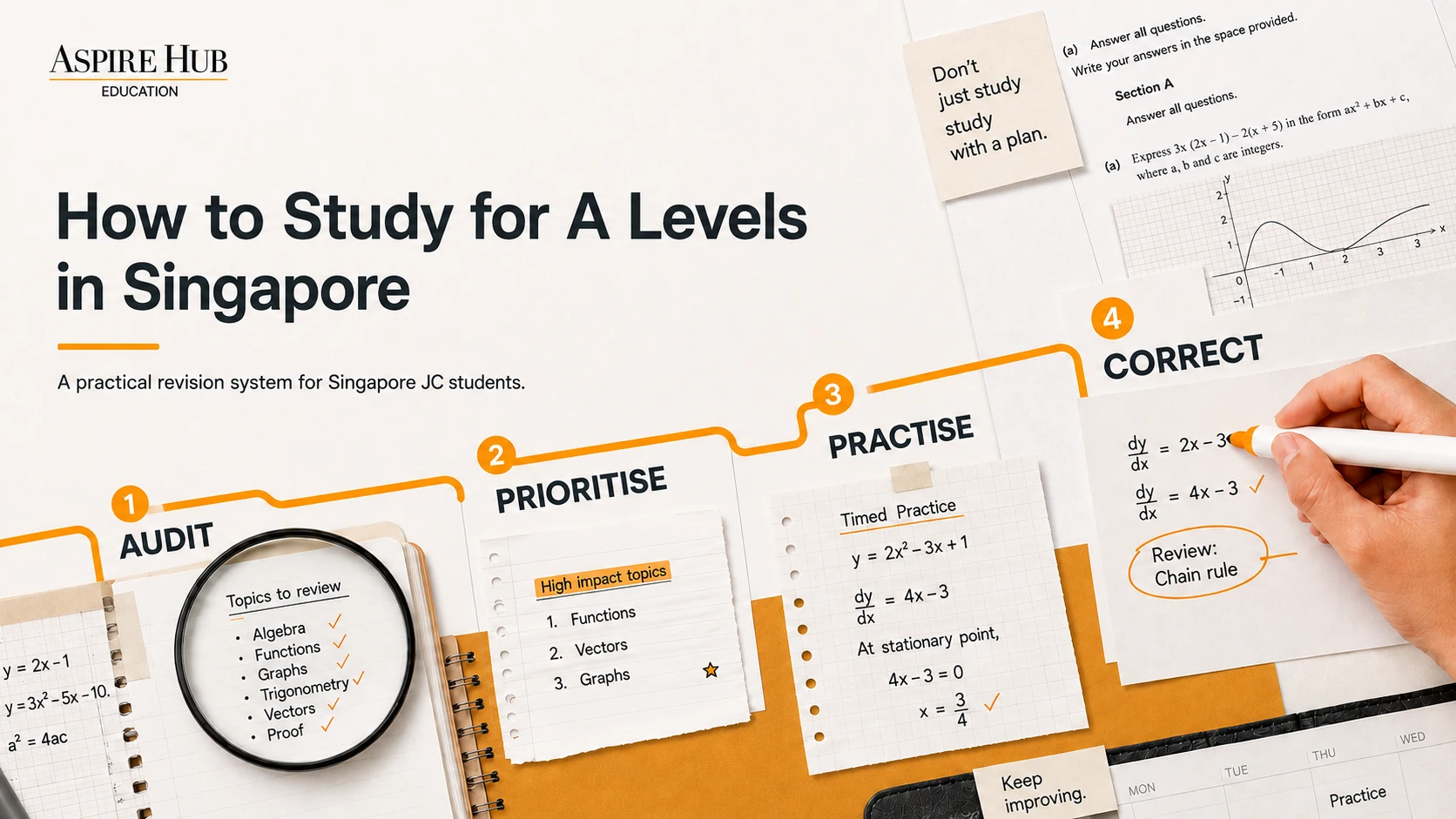
Many students start searching “how to ace A levels” when they realise that working harder does not always mean improving faster.
A Levels can feel demanding because students are not preparing for just one paper. They are managing multiple subjects, different exam formats, lectures, tutorials, prelims, revision packages, school commitments, and the pressure of future university pathways.
For many JC students, the challenge is not only the amount of content. It is knowing how to use that content well.
They need to understand what each subject is really testing. They need to know where their current gaps are. They need to practise under exam conditions, learn how marks are awarded, and build a routine that they can keep going until the final paper.
That is why A-Level preparation should not only be about memorising more notes or adding more study hours.
A better question is not just:
“How do I study more?”
It is:
“How do I study in a way that actually helps me perform better?”
To ace A Levels, students need a realistic game plan. One that helps them strengthen content, practise with purpose, understand marking expectations, use subject-specific strategies, and stay steady through the pressure of the exam year.
Understand What the A-Level Exam Is Really Testing
Before students think about how to ace A levels, they need to understand why A Levels feel different from earlier exams.
At A-Level, students are not only expected to remember what they have learnt. They need to apply ideas, compare concepts, interpret data, write with clarity, solve unfamiliar problems, and make decisions under time pressure.
This is where many JC students feel the jump.
A student may have done well before by memorising notes and practising familiar question types. But at A-Level, the question may look different from the example in the notes. A familiar topic may appear in a new context. An essay may require not only content, but also structure, evidence, evaluation, and judgement.

That is why students should not study every subject in the same way.
H2 Math requires method fluency and careful problem-solving. GP requires argument, examples, and evaluation. H2 Chemistry requires concept links, calculations, and precise explanation. Economics requires frameworks, diagrams, application, and judgement.
Each subject rewards something different.
So instead of treating A-Level revision as one big pile of notes to memorise, students should start by asking:
What does this subject actually reward in the exam?
That question helps students revise with more direction. Once they know what the paper is testing, they can choose better revision methods, practise the right skills, and stop wasting time on study habits that do not lead to marks.
Know Your Current Grade Gap Before Planning Revision
One common mistake students make is starting revision with the thought:
“I need to study everything.”
For A Levels, that can become overwhelming very quickly.
There are too many subjects, topics, papers, tutorials, and revision materials to go through without a clear direction. If students try to revise everything at the same level of urgency, they may spend a lot of time studying but still feel unsure about what is actually improving.
A better starting point is to understand the grade gap.
This means knowing where the student is now, where they hope to be, and what is stopping them from moving closer to that goal.
| What to Check | Why It Matters |
|---|---|
| Current grade | Shows the student’s starting point. |
| Target grade | Gives revision a clearer direction. |
| Weakest paper or component | Shows where the biggest mark loss may be happening. |
| Repeated mistakes | Reveals habits that need correction. |
| Subject priority | Helps students decide where to spend more revision time. |
This is more useful than revising blindly.
A student may not be weak in the whole subject. They may only be struggling with one paper, one topic cluster, or one type of question. For example, they may know the content but lose marks in application questions. They may write long essays but miss the evaluation point. They may practise Math regularly but keep losing marks through careless algebra mistakes.
Once the grade gap is clearer, revision becomes more focused.
Instead of asking:
“How many hours should I study?”
students can ask:
“What must I improve this week to move closer to my target?”
That shift makes A-Level preparation more manageable. Students are no longer trying to fix everything at once. They are learning to focus on the areas that can make the biggest difference.
Use Mock Exams and Prelims as a Diagnosis, Not a Final Judgement
Mock exams and prelims can feel discouraging, especially when the results are lower than expected.
For many students, a weak prelim result feels like a warning sign. They may start thinking that there is not enough time left, or that all their revision has not worked. But a prelim result should not be treated only as a final judgement of ability.
It should be treated as information.
A prelim paper shows what is still unstable, what needs more practice, and what should be fixed before the final exam. It can reveal whether the issue is a weak topic, poor timing, unclear answer structure, careless mistakes, or difficulty applying concepts under pressure.
That is why reviewing the paper properly is just as important as sitting for it.
A student should not only look at the final grade and move on. They should go through the paper and ask:
Where did the marks go?
Was it a content gap, application issue, timing problem, weak structure, or careless mistake?
Which mistakes have appeared before?
Which mistakes can be fixed quickly, and which ones need deeper revision?
This helps students avoid panic revision.
Instead of trying to redo every topic at once, they can sort their mistakes into clearer priorities:
| What the Prelim Shows | What Students Should Do Next |
|---|---|
| One weak topic keeps appearing | Rebuild the concept and practise targeted questions. |
| The student runs out of time | Practise timed sections and learn when to move on. |
| Answers sound correct but do not score | Review mark schemes, keywords, structure, and evaluation. |
| Careless mistakes keep repeating | Track the mistake pattern and build better checking habits. |
| Full papers feel overwhelming | Build exam stamina with timed paper practice. |
This is what makes prelims useful.
A disappointing result can feel painful at first, but it can also show the fastest path forward. Once students know where the marks are being lost, they can stop revising blindly and focus on the changes that are most likely to improve their final performance.
Learn the Mark Scheme, Not Just the Content
One important part of learning how to ace A levels is understanding that exams do not reward effort directly.
They reward answers that meet the marking expectations.
This is why students can study hard, know the content, and still feel disappointed when the marks come back. The issue is not always that they did not revise enough. Sometimes, they did not show the answer in the way the paper expected.
A student may lose marks because the answer is too vague. They may miss a keyword, skip a calculation step, give an example without explaining its relevance, or write a long answer that does not directly address the question.
This is where the mark scheme becomes useful.
It shows students what the examiner is actually looking for.
| Subject Type | What the Mark Scheme May Reward |
|---|---|
| Science subjects | Precise terms, correct reasoning, data interpretation, and explanation linked to theory. |
| Math subjects | Correct method, clear working, accuracy, and logical steps. |
| GP and Humanities | Argument structure, relevance, examples, evaluation, and answering the question directly. |
| Economics | Diagrams, economic reasoning, application to context, and evaluation. |
This does not mean students should memorise mark schemes blindly.
It means they should study the difference between an answer that sounds correct and an answer that scores.
For example, a GP paragraph may sound fluent, but still be weak if it does not answer the question directly. A Chemistry explanation may show understanding, but lose marks if the key chemical term is missing. In Math, even if the final answer is wrong, clear working may still help the student earn method marks.
So after checking an answer, students should ask:
What exactly earned the mark here?
Which keyword, step, example, or explanation was needed?
Why did this answer score more than mine?
What should I repeat next time?
The mark scheme helps students turn knowledge into marks.
That is the difference between studying hard and studying strategically.
Build Subject-Specific Exam Tactics
A-Level revision cannot be one-size-fits-all.
A student may spend hours studying, but if they use the same method for every subject, the results may not improve much. Reading notes may help with content-heavy subjects, but it may not be enough for Math. Memorising examples may help with GP, but it will not work if the student cannot build an argument. Doing practice questions may help Chemistry, but only if the student reviews why the answer did or did not score.
Each subject rewards different skills, so each subject needs a different revision tactic.
| Subject | What Students Should Focus On |
|---|---|
| GP | Building clear arguments, using relevant examples, evaluating ideas, and answering the question directly. |
| H2 Math | Choosing the right method, practising under time pressure, correcting repeated errors, and showing clear working. |
| H2 Chemistry | Connecting concepts across topics, organising organic reactions, handling calculations, and writing precise explanations. |
| Economics | Using frameworks, drawing and explaining diagrams, applying concepts to the case, and adding evaluation. |
| Humanities | Organising content, planning essays, analysing sources, and developing a clear argument flow. |
This helps students avoid vague revision plans like “study GP” or “revise Chemistry”.
A stronger plan should say exactly what skill they are working on. For example:
H2 Math: complete one timed set of integration questions and redo mistakes.
GP: plan two essay outlines with examples and evaluation points.
H2 Chemistry: revise equilibria, then attempt data-based questions without notes.
Economics: practise one case study question and check whether the evaluation is clear.
This makes revision more targeted.
Instead of trying to cover every subject in the same way, students learn to ask:
What does this subject need me to do well in the exam?
That question helps them choose the right task, practise the right skill, and make better use of their revision time.
Turn Revision Into Active Practice
Many students spend a lot of time with their notes, but not all note revision leads to improvement.
Reading, highlighting, and rewriting can feel productive because the content looks familiar. But in an exam, students are not asked to recognise the notes. They need to recall ideas, apply them, and explain them clearly without being guided.
That is why A-Level revision should include active practice, not only passive reading.
A useful way to check whether revision is working is to ask:
Can I use this without looking at the notes?
For example, after revising a Chemistry topic, students can close the notes and write out the key steps, conditions, or explanations from memory. For Math, they can attempt mixed questions and decide which method applies before checking the solution. For GP, they can take an example and practise using it inside an argument, instead of only memorising the example itself.
This helps students test whether they truly understand the content, or whether it only feels familiar because the notes are in front of them.
Active practice can include:
| Passive Revision | Active Practice |
|---|---|
| Reading notes | Writing a closed-book summary |
| Highlighting examples | Explaining how the example supports an argument |
| Looking through formulas | Choosing the correct method in a question |
| Reading solutions | Attempting the question first, then checking |
| Copying corrections | Redoing the question without help |
The goal is not to stop reading notes completely. Notes are still useful for learning and review. But students should not stop there.
To improve A-Level performance, they need to turn revision into tasks that test memory, application, and explanation. That is what helps them move from:
“I have seen this before.”
to:
“I can use this when the question looks different.”
Build a Weekly Revision System That Fits Real JC Life
A good revision plan should not only look organised. It has to work in a real JC week.
Most students do not have unlimited time. There are lectures, tutorials, CCA, homework, consultations, family commitments, and days when energy is low. So a plan that says “study every subject every day” may look disciplined, but it can become difficult to follow.
A better approach is to give each revision block a clear purpose.
| Revision Focus | What to Do | Example |
|---|---|---|
| Weak-topic repair | Go back to topics that still feel unclear after lectures or tutorials. | Revisit one confusing Chemistry concept and attempt five related questions. |
| Practice and application | Check whether the content can be used without looking at notes. | Complete one timed H2 Math question set before checking the solution. |
| Correction time | Review mistakes properly instead of only reading the correct answer. | Redo questions from a recent test and write down what caused each mistake. |
| Exam pacing | Practise working within time limits before prelims and A Levels. | Attempt one timed section from a past paper or prelim paper. |
| Consultation or support | Clear questions that still do not make sense after self-revision. | Ask a teacher, tutor, or coach about the questions that remain confusing. |
| Recovery and reset | Keep energy stable so revision can continue across the week. | Use lighter review, flashcards, or rest after a heavy school day. |
This kind of system works better because each session has a clear job.
A student who only reads notes may feel prepared, but struggle when the question looks different. A student who only does practice papers may repeat the same mistakes if they never review them properly. A student who studies late every night may look hardworking, but become too tired to revise well.
The goal is not to fill every free hour with studying.
The goal is to make sure each week includes learning, practice, correction, timing, support, and recovery. When these parts are balanced, revision becomes less random and more sustainable.
A Levels are not prepared for in one perfect study day. They are built through many steady weeks of focused revision, proper correction, and enough energy to keep going until the final paper.
Protect Your Energy Until the Final Paper
A-Level preparation is not only academically demanding. It can also be physically and emotionally tiring.
Students are managing lectures, tutorials, tests, prelims, revision, full papers, school commitments, and pressure about future pathways. That is a lot to carry.
When exams get closer, many students feel they must keep pushing, even when they are exhausted. They may sleep less, skip breaks, compare themselves with friends, or feel guilty whenever they are not studying.
But a tired student cannot revise well for long.
They may sit at the desk for hours, but absorb very little. They may make more careless mistakes, lose patience with difficult questions, or feel discouraged after one bad result.
This is why well-being matters in A-Level preparation.
Students still need discipline, practice, and serious revision. But they also need enough rest, proper meals, emotional support, and space to recover when things feel difficult. A healthier routine is not a distraction from exam preparation — it helps students keep going.
Parents can support this by looking beyond study hours. Sometimes, a helpful question is:
“What felt difficult today?”
“Which part do you need help with?”
“Are you getting enough rest to keep going?”

At Aspire Hub, we believe students should be supported both academically and emotionally. Preparing for A Levels should not mean burning out before the final paper.
The goal is to help students keep improving with structure, confidence, and a healthier rhythm that they can sustain until the exam.
When to Ask for Help with A-Level Preparation
Some students can prepare well on their own. Others may need extra support at certain points, especially when their grades stay stuck despite effort.
Asking for help does not mean the student is failing. It may simply mean they need clearer guidance, better structure, or someone to help them see what they cannot fix alone.
Students may need support when:
- Grades are not improving despite regular revision
- The same mistakes keep appearing
- Revision feels messy or unorganised
- They understand lessons but cannot apply concepts in tests
- They do not know how to use the mark scheme properly
- Prelims are near and there is no clear revision plan
- Confidence is dropping after repeated weak results
The key is to ask for the right kind of help.
If the issue is content, the student may need clearer explanation. If the issue is application, they may need guided practice. If the issue is answer structure, they may need feedback. If the issue is timing, they may need exam pacing. If the issue is repeated mistakes, they may need proper error review.
Good support should not simply add more homework. It should help students understand what is going wrong and what to do differently.
At Aspire Hub, JC support is built around this idea. Many students already have lecture notes, tutorials, school assignments, and practice papers. What they often need is clearer guidance on how to use those materials in a more focused way.
Through Aspire Hub’s JC coaching, students receive structured support across subject learning, revision planning, exam preparation, mistake review, and confidence building.
The aim is to help students move from passive revision to more independent exam readiness with clearer direction, steadier support, and a plan that matches where they are now.
FAQ: How to Ace A Levels
Have a question about A-Level preparation? Tap a question to expand it.
The best way to ace A Levels is to study with a clear system rather than simply putting in more hours.
Students should understand what each exam is testing, identify their current grade gaps, practise exam-style questions, review mistakes properly, learn the mark scheme, and use subject-specific revision methods.
Students should start building consistent study habits from J1, rather than waiting until J2 to get serious.
In J1, the focus should be on foundations, lectures, tutorials, and early topic understanding. In J2, preparation should become more exam-focused, with timed practice, prelim review, mark scheme analysis, and full-paper preparation.
Yes. Prelim results are important because they show students where the gaps are before the final exam.
A weak prelim result shouldn’t be ignored, but it also shouldn’t be treated as the final outcome. Students should use prelims to identify weak topics, timing issues, repeated mistakes, and papers that need more attention.
Both matter, and neither works well without the other.
Content helps students understand the subject, while past papers and exam-style questions help them apply knowledge under exam conditions. Students who only read notes may struggle with application; those who only do papers without reviewing mistakes may repeat the same errors.
Use the mark scheme to understand what actually earns marks, not just to check whether an answer is correct.
Look at keywords, working steps, evaluation points, accepted explanations, and common marking patterns. This helps students learn how to write answers that match exam expectations, not just answers that sound correct.
Plan by subject priority, not just by time spent.
Weaker or higher-impact subjects may need more attention, but stronger subjects still need maintenance. A good weekly plan should include content review, practice questions, correction time, timed practice, and rest.
Identify exactly why the marks are being lost before revising more.
The issue may be weak content, poor application, careless mistakes, weak answer structure, timing, or poor mistake review. Once the pattern is clearer, revision can become far more targeted.
Tuition can help if it gives clearer explanations, structured revision, guided practice, and feedback on mistakes, not just more homework.
Good support should help students understand their gaps, practise the right questions, and prepare for exams with better direction.
Yes. Aspire Hub’s JC coaching supports students across subject learning, revision planning, exam preparation, mistake review, and confidence building.
Contact Aspire Hub to discuss which subjects your child needs support with and where their grade gap currently is.
Coaches review a student’s prelim papers, tutorials, and past answers to identify whether the gap is content, application, timing, structure, or repeated careless mistakes.
That diagnosis shapes the revision plan that follows, so preparation stays focused on what will actually move the grade.
Final Thoughts
Ready to Approach A Levels with a Clearer Plan?
Acing A Levels does not come from one perfect study trick.
It comes from knowing what to focus on, practising with purpose, and building a revision system that students can keep going until the final paper.
By this stage, students should not only ask, “How many hours should I study?” They should also ask:
Where are my marks being lost?
Which subjects need more attention?
Am I revising in the way each paper is tested?
Do I know how to turn my mistakes into improvement?
The students who improve are not always the ones who study the longest. They are often the ones who understand their gaps, use prelims and practice papers properly, learn from mark schemes, and stay consistent without burning out.
At Aspire Hub, our JC coaching helps students prepare for A Levels with structured guidance, subject support, exam practice, mistake review, and confidence-building throughout the revision journey.
Need support with A-Level preparation?
Contact Aspire Hub to speak with our team about the JC support that may suit your child.