Learning Chinese in Secondary School requires more than remembering vocabulary and model answers. Students must interpret increasingly complex material, organise their ideas and communicate accurately across written, spoken and listening components.
The transition can reveal learning gaps that were less obvious in Primary School. A student may recognise many words but struggle to use them appropriately. Another may understand a comprehension passage yet provide incomplete answers. Some students have relevant ideas but cannot develop them clearly in a composition or oral discussion.
Families comparing secondary Chinese tuition Singapore programmes should therefore look beyond the volume of worksheets provided. Effective coaching should identify what is preventing progress and help students apply the language with increasing confidence and independence.
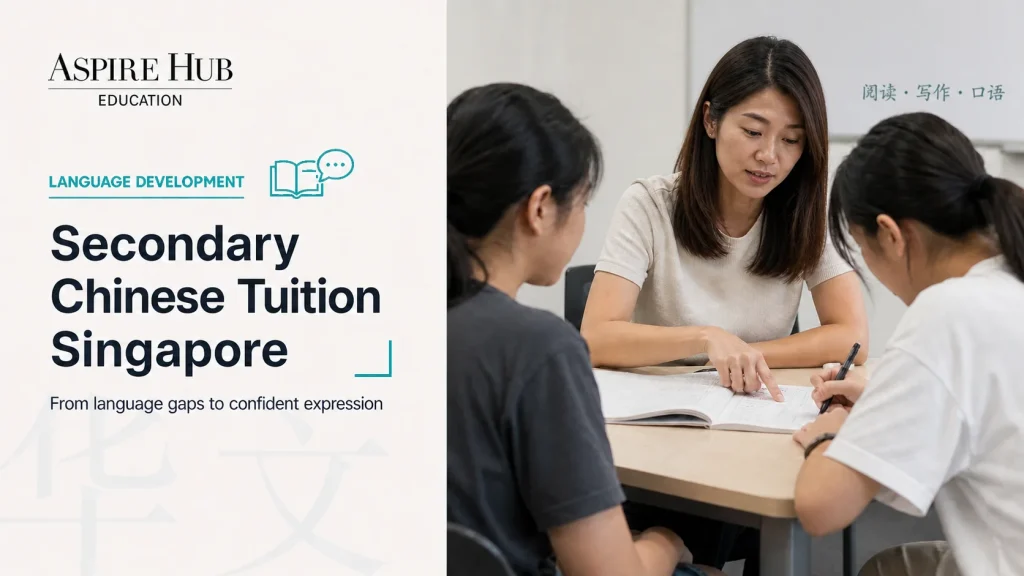
At Aspire Hub, Chinese learning is treated as a progressive journey. Through structured small-group academic coaching, students develop their foundations, organise their thinking and strengthen how they communicate.
At a glance: Secondary Chinese development connects vocabulary, language application, comprehension, writing, listening and oral communication. Students need clear explanations, purposeful practice and feedback that turns mistakes into practical next steps.
Why Chinese Becomes More Challenging in Secondary School
Secondary Chinese does not become challenging only because students have more words to learn. The larger change is that they must use the language with greater flexibility and precision.
Memorising phrases may help with a familiar exercise, but it may not prepare a student to interpret a new passage, respond to an unexpected composition topic or explain a personal view during an oral examination.
Vocabulary must move from recognition to application
Vocabulary knowledge has several levels. A student may recognise a word when reading, understand its approximate meaning and still be unable to use it correctly.
To apply a word independently, the student must understand its context, tone, grammatical role and relationship with surrounding words. Similar-looking expressions may carry different implications or suit different situations.
A student who studies vocabulary only through definitions may therefore perform well in short recall exercises but continue using limited or inappropriate language in compositions.
Stronger vocabulary development connects four stages:
- Recognising the word
- Understanding it in context
- Distinguishing it from similar expressions
- Applying it naturally in writing or speech
This progression helps transform passive vocabulary into language the student can use.
Comprehension requires more than finding information
Secondary-level comprehension assesses different forms of understanding. Some questions require direct retrieval, while others test inference, explanation or the interpretation of language in context.
Students commonly lose marks in several ways. They may copy an entire sentence without answering the precise question. They may identify the correct section of a passage but omit an essential detail. Others understand the answer mentally but express it too vaguely.
Effective comprehension work should teach students to:
- Identify the demand of the question
- Locate relevant textual evidence
- Distinguish essential information from supporting detail
- Express the answer with appropriate precision
- Check whether every part of the question has been addressed
Reviewing the final answer alone is insufficient. Students need to examine the reasoning that produced it.
Composition requires decisions at every stage
A composition is not simply a long vocabulary exercise. Students must make decisions before and during writing.
They need to interpret the topic, select an appropriate direction, organise events or arguments and decide which details deserve development. They must then express those ideas using suitable vocabulary, sentence structures and transitions.
Different weaknesses can produce a similar low result:
| Visible issue | Possible underlying cause |
|---|---|
| Composition is too short | Insufficient planning or difficulty developing ideas |
| Story feels repetitive | Limited event progression or paragraph purpose |
| Writing moves away from the topic | Weak question analysis |
| Ideas are relevant but unclear | Limited sentence control or organisation |
| Vocabulary is simple | Small active vocabulary or fear of making mistakes |
| Ending feels sudden | Poor time management or missing story structure |
A useful coaching process identifies which stage is breaking down. Giving the same model composition to every student may not address these different causes.
Oral communication requires content and interaction
Students sometimes approach oral preparation as a memorisation task. They prepare fixed expressions but struggle when the topic or examiner’s question changes.
Strong oral communication requires several abilities at once. Students must understand the stimulus, form a relevant view, organise their response and elaborate with explanations or examples. They must also listen to follow-up questions and respond naturally.
Fluency does not mean speaking quickly. A strong response is clear, relevant and sufficiently developed. Natural pacing, appropriate vocabulary and logical organisation matter more than speed alone.
Where Do Students Commonly Struggle?
Chinese language components are connected. A weakness in one area can affect several others.
| Language area | Common difficulty | Development focus |
| Vocabulary and language use | Recognising words but applying them incorrectly | Context, distinction and active use |
| Reading comprehension | Giving incomplete or unsupported responses | Question analysis, evidence and precise expression |
| Composition | Weak ideas, organisation or elaboration | Planning, development and language control |
| Oral communication | Hesitation or limited explanation | Response organisation and purposeful discussion |
| Listening | Missing details or implied meaning | Active listening, note retention and review |
This connection is important when evaluating a tuition programme. A student who appears weak in composition may actually have a planning problem. A weak oral response may result from limited topic knowledge rather than pronunciation.
The visible mistake is evidence. It is not always the diagnosis.
How Learning Needs Change from Secondary 1 to 4
Chinese development should remain connected across the four Secondary years, but the emphasis changes as students mature and examination demands increase.
Secondary 1: establishing a reliable foundation
Secondary 1 students are adapting to a larger language load and more demanding tasks. They may encounter unfamiliar writing expectations while still carrying vocabulary or comprehension gaps from Primary School.
At this stage, coaching should establish reliable habits. Students need to learn how to record and revisit vocabulary, analyse comprehension questions and plan written responses.
Confidence is especially important during this transition. If students repeatedly feel lost, they may begin avoiding the language instead of engaging with it.
Secondary 2: connecting knowledge with application
By Secondary 2, students are expected to use language more consistently. They encounter more complex texts, require a wider range of expressions and need to explain ideas more fully.
Vocabulary should no longer remain within isolated exercises. Students should learn to apply new language in comprehension responses, compositions and discussions.
This stage is also useful for correcting weak habits before Upper Secondary examination preparation begins.
Secondary 3: developing examination maturity
Secondary 3 introduces greater demands in question analysis, answer organisation and time management.
Students need to recognise which weaknesses will have the greatest impact later. A composition difficulty identified at this stage can be addressed progressively, whereas the same problem becomes more difficult to resolve when preparation is left until the graduating year.
Practice should increasingly reflect examination demands, but it should still be used diagnostically. The purpose is not only to calculate a score; it is to identify what the student needs to improve.
Secondary 4: consolidating and refining performance
Secondary 4 students must connect their language skills under examination conditions. Coaching should prioritise high-impact weaknesses while refining pacing, answer presentation and checking.
Repeatedly completing full papers is not always the most efficient approach. A student who consistently misinterprets comprehension questions may need focused question analysis before returning to another full paper.
Aspire Hub believes that structure precedes speed. Students first need a method they can apply reliably. Speed can then develop without sacrificing accuracy.
Chinese and Higher Chinese: Different Learning Demands
Chinese and Higher Chinese are separate subjects with different levels of linguistic depth. Students should receive coaching that reflects the subject they take.
For the 2026 GCE O-Level examinations, SEAB lists Chinese (1160) and Higher Chinese (1116) as separate subjects.
From 2027, the Singapore-Cambridge Secondary Education Certificate will replace the N- and O-Level examinations. Students will take subjects at G1, G2 or G3 levels, including G3 Higher Mother Tongue Language.
| Area | Chinese | Higher Chinese |
| Language depth | Develops core Secondary Chinese proficiency | Requires greater depth and linguistic control |
| Reading | Comprehension and application across text types | More demanding interpretation and analysis |
| Writing | Clear, relevant and organised expression | Greater maturity, precision and depth |
| Language exposure | Aligned with the student’s Chinese subject level | Requires sustained engagement with more sophisticated material |
| Coaching emphasis | Strengthen foundations and application | Deepen analysis, expression and independent language use |
Higher Chinese should not be described only as “harder Chinese”. It expects students to engage with more complex language and express ideas with greater maturity.
Suitability depends on the student’s foundation, interest, workload and school guidance. A programme should not use identical materials or expectations for both subjects.
Understanding the Current Chinese Assessment
For 2026 Chinese syllabus 1160, SEAB divides the assessment across writing, language application and reading comprehension, oral communication, and listening comprehension.
| Assessment area | Weighting | What students are expected to do |
| Writing | 30% | Complete functional writing and a composition |
| Language application and reading comprehension | 35% | Apply vocabulary in context and respond to different reading materials |
| Oral examination | 25% | Read aloud and discuss a video-based topic |
| Listening comprehension | 10% | Interpret spoken material across everyday and informational contexts |
The writing paper includes functional writing of at least 150 Chinese characters and a composition of at least 300 characters. Composition options include narrative, expository and argumentative forms.
The language application and comprehension paper includes contextual language use, vocabulary correction, practical texts and open-ended comprehension.
The oral examination includes reading aloud and conversation based on a video stimulus. SEAB’s assessment criteria consider pronunciation, clarity, pace, intonation, fluency, content development and language expression.
These details show why Secondary Chinese cannot be developed through one method alone. Students require both language knowledge and the ability to apply it differently across each component.

Parents should refer to the current SEAB Chinese syllabus for their child’s examination year. The transition to the SEC examination from 2027 does not itself change the examination format, but families should continue checking official updates for the relevant cohort.
When Might Additional Coaching Be Helpful?
Tuition is not necessary for every student. Some students make steady progress through school lessons, consultations and consistent independent practice.
Additional coaching may be useful when a difficulty continues despite genuine effort. Parents should look for patterns such as recurring comprehension errors, limited expression, underdeveloped compositions or reluctance to speak Chinese.
A few practical questions can help clarify the situation:
- Does the student understand why marks were lost?
- Do the same mistakes continue appearing?
- Can the student apply feedback without repeated prompting?
- Is one foundational weakness affecting several components?
- Has repeated difficulty reduced the student’s willingness to use Chinese?
A suitable programme should respond to the underlying difficulty rather than simply increase the workload.
At Aspire Hub, progress precedes pressure. Before expecting stronger performance, students need clarity about what is preventing improvement and a practical route forward.
What Effective Secondary Chinese Coaching Should Develop
Strong Chinese coaching should connect language understanding with application. Vocabulary, comprehension, writing and communication should reinforce one another.
Contextual vocabulary development
Students should learn vocabulary through meaningful material rather than definitions alone. A new expression can be introduced through a passage, examined in context and then applied in discussion or writing.
This helps students understand not only what a word means, but when and how it should be used.
Vocabulary review should also be selective. Revisiting the words a student repeatedly misuses may be more valuable than adding a large number of unrelated expressions.
Comprehension reasoning
Students need a repeatable process for approaching comprehension:
- Identify what the question requires.
- Locate the relevant section.
- Determine which details answer the question.
- Express the response precisely.
- Check that no part has been omitted.
This process should guide thinking without becoming a rigid template. Students must still respond to the meaning and structure of each text.
Independent composition writing
Composition coaching should cover the entire process from interpretation to revision.
Before writing, students need to understand the topic, choose a direction and plan how the content will develop. During writing, they need to maintain relevance and manage time. After writing, they should review organisation, language accuracy and clarity.
Feedback should lead to transferable learning. Instead of only rewriting one weak paragraph, the student should understand the principle that would improve future compositions.
Confident oral communication
Oral coaching should help students build both content and language.
A useful response often develops from a clear position into an explanation, example and broader reflection. However, students should not be forced into a mechanical formula. The structure is a support until they can communicate more naturally.
Discussion of current and everyday topics can also improve background knowledge, vocabulary and the ability to form opinions.
How the Aspire Coaching Framework™ Turns Gaps into Progress
Aspire Hub uses a five-stage coaching process.
| Stage | Application to Secondary Chinese |
| Diagnose | Identify language gaps, recurring errors and ineffective habits |
| Clarify | Break difficult language skills into understandable components |
| Structure | Develop approaches for comprehension, composition, oral and revision |
| Strengthen | Reinforce learning through purposeful practice and feedback |
| Elevate | Refine examination application, accuracy and confidence |
From a visible error to a useful next step
Consider a student who repeatedly receives weak composition results. The immediate assumption might be that the student needs a larger vocabulary.
A closer review may show that the student already knows enough words but cannot organise ideas. The story contains several events, yet none is developed sufficiently. The ending then becomes rushed because too much time was spent deciding what to write.
The solution is not another vocabulary list. The student first needs a planning method that identifies the central event, supporting development and intended conclusion.
Once that structure becomes more reliable, vocabulary and sentence work can strengthen the expression. Timed practice is introduced after the student can produce a coherent response with less guidance.
This is how the Aspire Coaching Framework™ connects diagnosis with action. Understanding builds clarity, structure builds consistency and demonstrated progress builds confidence.
Purposeful Resources, Not More Worksheets
Learning resources should connect knowledge with application. They should not simply increase the quantity of work a student completes.
A balanced resource set may include:
- Contextual vocabulary and language-use exercises
- Practical and literary comprehension material
- Guided composition planning
- Oral discussion stimuli
- Listening activities
- Examination-style practice
Each task should have a clear purpose. One may isolate a recurring vocabulary error, while another requires the student to apply that vocabulary within a composition or discussion.
The sequence also matters. Students who attempt repeated full papers before resolving a fundamental language gap may continue making the same mistakes.
The useful question is not how many worksheets a programme provides. It is how the work is selected, reviewed and used to determine the next learning step.
Why Aspire Hub Uses Small-Group Coaching
Students often require more interaction than a large class can provide, but they must also learn to work independently. Aspire Hub’s structured small-group coaching model creates space for both.
In comprehension, coaches can observe how students interpret a question instead of seeing only the final answer. During composition planning, students can explain why they selected a particular direction. Oral discussions allow them to compare viewpoints and practise responding to one another.
These interactions reveal thinking that may remain hidden in completed work.
Students follow a shared learning objective, but they are not expected to have identical strengths. Coaches can respond to difficulties demonstrated during the lesson while maintaining a structured group environment.
Small-group coaching also develops accountability. Students are expected to participate, apply feedback and take increasing responsibility for their learning.
Feedback That Changes the Next Attempt
Marking a response as correct or incorrect is only the beginning. Useful feedback identifies why the response was ineffective and what the student should change.
For comprehension, feedback might distinguish between missing evidence and unclear expression. For composition, it may address relevance, development, organisation or language accuracy. In oral practice, it may focus on content, elaboration, fluency or natural interaction.
When an error continues recurring, assigning more questions may not help. The coach may need to revisit an earlier skill, adjust the explanation or reduce the difficulty temporarily.
Feedback becomes meaningful when the student can apply it to the next task. The goal is not only to correct yesterday’s work but to improve tomorrow’s decision-making.
Preparing for Examinations Without Neglecting Language Development
Examination preparation should help students apply their language skills more consistently. It should not replace language development with repeated papers and memorised answers.
Functional and composition writing
For functional writing, students need to recognise the purpose, audience and required content before they begin. A response can be grammatically accurate and still lose marks if it omits important information or uses an unsuitable tone.
Composition writing involves a different set of decisions. Students must interpret the topic, select relevant ideas and organise them into a coherent response. Narrative writing may require clear event progression and meaningful elaboration, while expository or argumentative writing depends on logical development and relevant support.
A checking routine can help students identify whether they have answered the question fully, developed important points and avoided unclear or inaccurate expressions.
Language application and comprehension
Students should practise using contextual clues, distinguishing between similar expressions and recognising vocabulary that has been used inappropriately.
Comprehension review should separate different types of errors. A student who misunderstands a word requires different support from one who identifies the correct evidence but gives an incomplete answer. Treating every incorrect response as a comprehension problem can hide the actual weakness.
Students can read what to consider when preparing for O-Level Chinese before Secondary 4 for a closer look at Upper Secondary Chinese preparation and the challenges that may become more visible closer to the examination year.
Oral communication
Reading aloud requires accurate pronunciation, clear delivery, appropriate pacing and natural intonation. Students should avoid rushing simply to sound fluent.
During conversation, students need to present relevant ideas, organise their response and elaborate with explanations or examples. Practice should also prepare them to listen carefully and respond naturally to follow-up questions rather than deliver a memorised speech.
Listening comprehension
Listening practice should develop more than general exposure to spoken Chinese. Students need to identify key details, follow how information develops and distinguish between similar answer options.
Reviewing an incorrect answer is essential. The student should determine whether they missed an important word, misunderstood the context, confused two details or forgot information heard earlier.
Examination strategy
Timed practice becomes useful after students have established a reasonably reliable approach. They can then work on pacing, answer presentation and checking without reinforcing rushed habits.
Full papers should be used to diagnose performance, while targeted exercises address the specific weaknesses those papers reveal. This balance helps students prepare for examination conditions without neglecting the language development needed for sustainable improvement.
For more revision advice, subject articles and study strategies across different levels, explore Aspire Hub Learning Resources.
Recognising Progress Before It Appears in a Grade
Examination results matter, but meaningful development may appear before a major grade change.
A student may begin selecting vocabulary more accurately, planning compositions with less prompting or supporting comprehension answers with better evidence. Another may become more willing to participate in Chinese discussions.
These improvements show that the student is developing stronger language judgement and independence.
At Aspire Hub, progress is considered in context. Where did the student begin? What was preventing improvement? What changed after structured guidance?
Student stories should describe this development rather than present a headline grade without explanation. Personal and academic information should also be shared only with appropriate consent.
Onsite and Online Coaching Across Singapore
A programme must fit the student’s weekly routine. An inconvenient location or unsuitable timetable can make consistent attendance difficult.
Aspire Hub has 16 locations across Singapore, allowing families to explore a centre near their home or school. Online coaching is also available for students who need greater flexibility.
Aspire Hub provides flexible fee options for onsite and online classes. Parents can contact the customer service team to check current schedules, vacancies and fees. They should also confirm what the programme includes and how replacement lessons are arranged.
Families comparing secondary Chinese tuition Singapore options can use a consultation to discuss the student’s current language difficulties and identify a suitable class, location and learning format.
Choosing a Programme That Fits the Student
The right programme is not necessarily the largest or most heavily promoted. It is the one that understands the student’s difficulties and provides a clear route towards stronger language application.
| What to assess | Questions to consider |
| Subject alignment | Does the programme support Chinese or Higher Chinese at the correct level? |
| Curriculum | Does it reflect current syllabus and assessment requirements? |
| Diagnosis | How are language gaps and recurring mistakes identified? |
| Coverage | Are vocabulary, comprehension, writing, oral and listening addressed? |
| Class environment | Can students participate and receive focused guidance? |
| Practice | Does work progress from understanding to independent application? |
| Feedback | Is completed work reviewed with clear next steps? |
| Progress | How are improvements and persistent difficulties monitored? |
| Practical fit | Are the format, schedule, location and fees sustainable? |
Parents should pay particular attention to what happens when a student does not understand. Effective coaching should identify the cause, clarify the relevant skill and guide the student towards independent application.
The goal is not merely to complete more exercises. It is to help students use Chinese with greater clarity, confidence and control.
Building Confidence Through Stronger Language Skills
Choosing secondary Chinese tuition Singapore support should begin with the student rather than a provider’s marketing claims.
Parents should understand which language areas their child finds difficult, what learning environment suits them and how much additional work they can manage. They can then look for accurate curriculum coverage, clear explanations, purposeful practice and feedback that leads to action.
At Aspire Hub, every student is recognised as an individual with unique strengths and challenges. We walk with students through each stage of their learning journey, helping them build the clarity, structure and confidence to communicate more independently.
We don’t just teach. We coach.
FAQ: Secondary Chinese Tuition Singapore
Have a question about Secondary Chinese coaching at Aspire Hub? Tap a question to expand it.
Fees vary according to lesson format, duration, group size and the level of support provided.
Private tuition generally costs more than small-group programmes because the lesson is dedicated to one student. Aspire Hub offers flexible fee options for onsite and online classes, and parents can contact the customer service team for current fees, schedules and programme availability.
No. Some students progress well through school lessons, consultations and consistent independent practice.
Additional coaching may help when the same difficulties persist, a weak foundation affects several components, or the student needs more structure and feedback than they currently receive.
A student should seek support as soon as a recurring difficulty becomes clear, rather than waiting until the final examination period.
Waiting too long may leave insufficient time to rebuild vocabulary, comprehension or writing foundations. Secondary 1 and 2 students can focus on language habits and consistent application, while Secondary 3 and 4 students may need a more examination-focused approach.
Chinese and Higher Chinese follow different syllabuses and levels of language depth, with Higher Chinese generally requiring more sophisticated reading, writing and language analysis.
Students should attend a programme designed for their subject, with materials, explanations and examination preparation that reflect the relevant level.
Higher Chinese can be demanding because students engage with more complex texts and must express ideas with greater depth and precision.
Its suitability depends on the student’s language foundation, interest, workload and school guidance. Parents should not make the decision solely based on perceived academic advantages.
A comprehensive programme may address vocabulary, language application, reading comprehension, composition, oral communication and listening.
The balance should depend on the student’s current level. A student with strong comprehension but weak expression requires a different focus from one with broader foundational gaps.
Composition coaching can help students interpret questions, generate relevant ideas, organise content and improve expression.
Feedback should explain why part of the writing is ineffective and how it can be strengthened. Students should gradually learn to plan and refine their own responses instead of relying only on memorised essays.
Students need to understand both the passage and the question. Improvement may involve building vocabulary, recognising question requirements, finding evidence and expressing answers with greater precision.
Reviewing mistakes is essential. Students should identify whether an error came from misunderstanding the text, misreading the question or giving an incomplete response.
Yes, when students receive regular opportunities to speak, organise their thoughts and respond to feedback.
Oral coaching should help students explain and elaborate on their views. Memorising fixed responses alone may not prepare them for unfamiliar topics or follow-up questions.
Neither format is universally better. Private tuition may suit students with highly specific needs or scheduling requirements.
Small-group coaching may suit students who benefit from discussion, structure, peer interaction and accountability. Teaching quality and useful feedback remain more important than format alone.
Online coaching can be effective when lessons remain interactive and students receive feedback on their spoken and written work.
Aspire Hub offers onsite and online options. Online classes may suit students who require flexibility, while onsite classes may appeal to those who prefer face-to-face interaction.
Yes. Aspire Hub supports students across the Secondary and IP Years 1 to 4 stage, with the coaching focus changing according to the student’s level and current needs.
Younger Secondary students generally focus on foundations and consistent application, while Upper Secondary students require greater examination maturity and strategic revision.
Through the Aspire Coaching Framework™, coaches examine where the student is experiencing difficulty.
This may include reviewing recent work, observing the student’s approach and identifying recurring errors. The purpose is to understand the cause before deciding what explanation or practice the student needs.
Resources may include vocabulary material, comprehension passages, writing exercises, oral prompts and examination-style questions, depending on the programme and student level.
Homework should support a clear learning objective and remain manageable alongside the student’s other commitments.
Progress may be reviewed through completed work, recurring mistakes, language application and assessment performance.
Grades are not the only indicator. More precise vocabulary, clearer writing, stronger comprehension answers and greater willingness to communicate are also meaningful signs of development.
Aspire Hub has 16 locations across Singapore, allowing families to explore a centre convenient to their home or school.
Online coaching is also available. Schedules and vacancies may vary, so parents should contact the customer service team for current options.
Yes. A consultation or trial session can help families understand the coaching environment before making a longer commitment.
It also allows the student to experience the teaching approach. Parents can contact Aspire Hub to ask about current consultation or trial options and available classes.
This depends on class availability, the topics currently being covered and the student’s existing foundation.
A consultation can help determine whether the student can join an available class directly or needs additional support to close earlier gaps.
Explore Aspire Hub’s Secondary Chinese Programme
If your child is struggling with Chinese or Higher Chinese, speaking with Aspire Hub can help clarify the next step.
Share your child’s language difficulties, learning habits, schedule and academic goals with our team. We can help you explore whether Aspire Hub’s structured small-group Secondary Chinese programme is suitable for their present stage.
Families can also ask about onsite and online classes, flexible fees, current schedules and availability across our 16 locations.