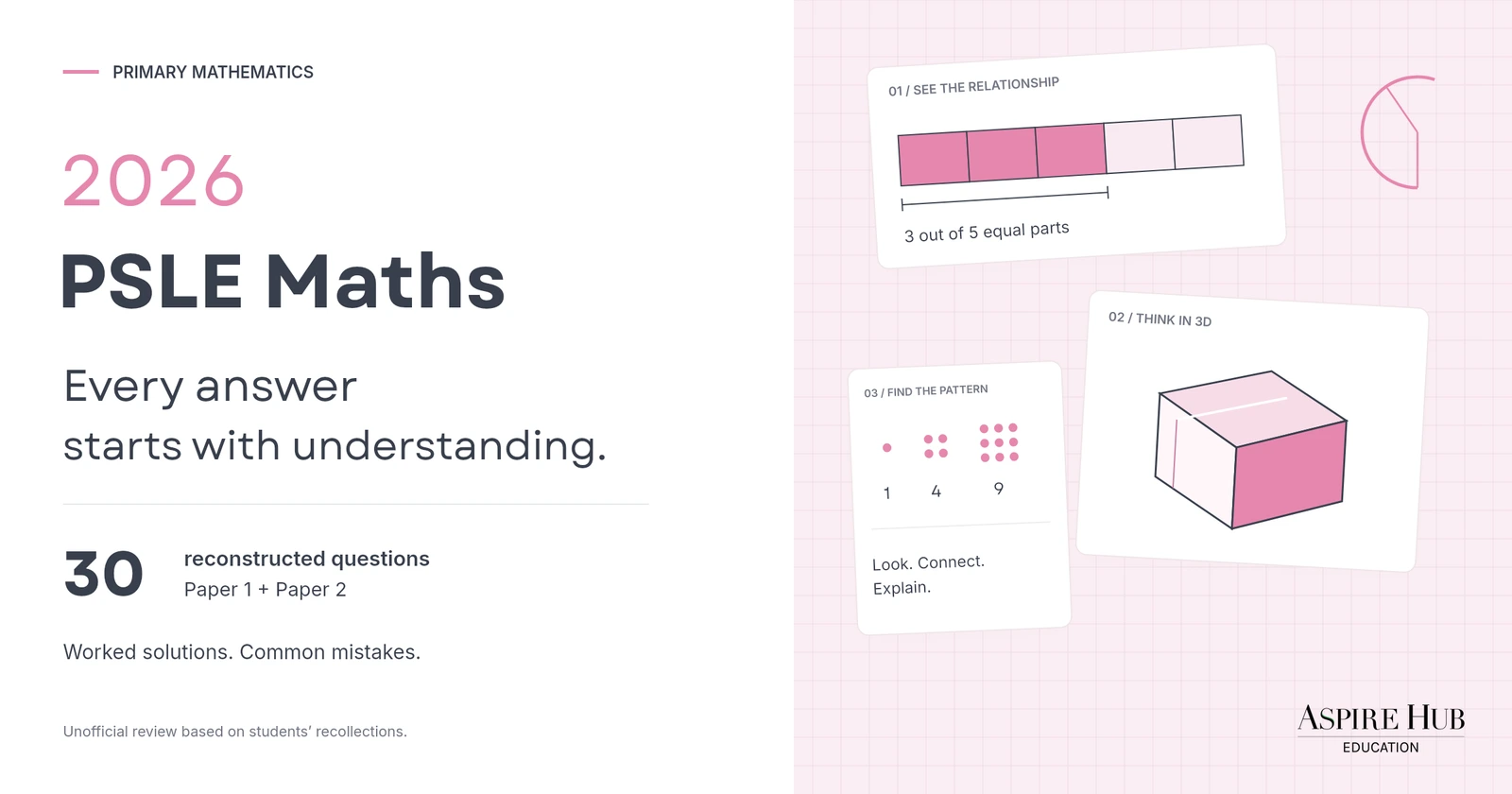
Looking for 2026 PSLE Maths questions and answers to understand where your child did well and which problems they found challenging? Aspire Hub’s review brings together 30 reconstructed questions: 20 from Paper 1 and 10 from Paper 2 with suggested answers, step-by-step worked solutions and common mistakes to watch for.
Whether your child overlooked a condition or struggled to approach an unfamiliar problem, the review helps you understand where their reasoning may have gone off track and what they can learn from it.
Explore the key learning points below, or contact Aspire Hub to request the full 30-question review PDF.
Aspire Hub’s 2026 PSLE Mathematics review brings together 30 reconstructed questions from Paper 1 and Paper 2, with suggested answers, worked solutions and common mistakes to watch for. The compilation gives families a way to revisit selected questions and understand the reasoning behind the answers.
For students preparing for a future PSLE, these questions also provide useful practice in reading precisely, applying concepts and organising multi-step solutions.
This article examines what the selected questions reveal about problem-solving—and how parents can turn a paper review into a clearer understanding of their child’s learning needs.
Looking for the worked solutions? Contact Aspire Hub and request “PSLE MATH 2026” to receive download details for the full 30-question review PDF.
This is an unofficial compilation reconstructed from students’ recollections, containing 20 Paper 1 questions and 10 Paper 2 questions. It is not the complete official examination paper or SEAB’s marking scheme. Recalled wording, values and diagrams may differ, and selected details remain under review.
For official examination information, visit the SEAB website.
What Does the 2026 PSLE Maths Review Cover?
The compilation covers selected questions involving fractions, percentages, rates, algebra, geometry, measurement, data interpretation and patterns.
Alongside suggested answers, the PDF explains how to approach each question and identifies mistakes that could lead to an incorrect result.
| Part of the review | What readers will find |
|---|---|
| Paper 1: 20 reconstructed questions | Core concepts, short calculations and interpretation of wording and diagrams |
| Paper 2: 10 reconstructed questions | Multi-step problems involving quantities, relationships and conditions |
| Worked solutions | The reasoning and calculations behind the suggested answers |
| Common mistakes | Examples of missed conditions and incorrect assumptions |
| Answer table | A quick reference across both papers |
The worked solutions are useful for checking an approach. The explanations of mistakes help answer a deeper question: What should the student practise next?
Why Familiar Maths Topics Can Still Feel Challenging
A student may recognise percentages, volume or ratio and still struggle to begin a question. Knowing the topic does not automatically reveal how the information fits together.
The reconstructed bike-booking problem, for example, requires students to interpret two pricing rules before comparing costs. The necklace problem requires them to track two colours of beads and identify which colour limits production. The painted-cube problem requires them to recognise new surfaces created by a cut.
In each case, the student must build a mathematical representation of the situation before calculating.
These examples help explain why a child can complete routine exercises confidently but hesitate when the same concepts appear in unfamiliar wording. The difficulty may lie in selecting and connecting ideas rather than recalling a formula.
A review of these selected questions cannot establish how difficult the entire 2026 PSLE Maths paper was. It can, however, highlight specific demands that families can look for in a child’s working.
Paper 1 Learning Points: Precision Before Calculation
The selected Paper 1 questions show how small differences in wording can affect the answer.
In the reconstructed screen-time challenge, the condition is to earn more than 65 points. A student who finds a combination worth exactly 65 points has completed a valid calculation but has not satisfied the question.
Fractions introduce a different kind of precision. In the camp question, one fraction refers to all the children, while another refers to the children in a single group. Students need to identify those different wholes before combining the quantities.
These examples suggest two useful habits:
- Restate the target: Write or say exactly what must be found, including any limit or condition.
- Label the quantities: Identify what each number, fraction or percentage represents.
Parents can encourage both by asking: “What does your answer need to show?”
That prompt helps reveal whether the child understands the task before attention shifts to arithmetic.
Paper 2 Learning Points: Connecting Several Steps
Multi-step problem sums require students to manage intermediate results while keeping the final question in view. The challenge is deciding what to calculate, in what order, and why.
Three learning points stand out in the reconstructed Paper 2 questions.
Keep Track of Changing Quantities
In the beads percentage question, a percentage applies to the beads remaining after some have already been used. The reference amount changes during the problem.
Students who calculate immediately may use the original amount throughout. A labelled bar model or a short sequence showing “original”, “remaining” and “given away” can make the relationships clearer.
The transferable skill is identifying the base of every fraction or percentage. This matters whenever a problem includes successive changes, transfers or remainders.
Check Every Constraint
In the necklace question, the total number of beads does not determine how many complete necklaces can be made. Each necklace needs specific quantities of white and red beads.
Students must check both supplies. One colour can run short while many beads of the other colour remain.
This reasoning applies beyond beads. Whenever a question involves making complete sets, arranging groups or using materials in fixed quantities, every requirement needs to be satisfied.
Work Systematically When Several Answers Are Possible
The square-base cuboid question asks for all possible heights. Finding a valid height is only part of the task.
Students also need a method for checking that no valid possibility has been missed. A table connecting base dimensions, base area and height makes the search easier to organise.
This is a useful distinction for parents reviewing work: an answer can be mathematically correct yet incomplete.
Geometry Questions: Understand the Figure Before Choosing a Formula
Geometry and measurement questions often combine calculation with visual reasoning.
In the reconstructed painted-cube question, cutting the solid exposes additional surfaces. In the cut-squares question, the position of a cut determines how the perimeter changes.
Students who begin with a familiar formula may overlook those structural details.
A more deliberate approach is to mark known lengths, identify repeated shapes and sketch the effect of the change. The question “What changed, and what stayed the same?” can guide that process.
When reviewing geometry, ask the child to explain the diagram before explaining the calculation. This helps distinguish a difficulty with visualisation from a difficulty with the formula or arithmetic.
Is It a Careless Mistake or a Learning Gap?
“Careless mistake” can describe several different problems. A child may have copied a number incorrectly, misunderstood a phrase, chosen the wrong reference quantity or lost track of a step.
Those errors need different responses.
| What appears in the working | What to explore | Useful follow-up |
|---|---|---|
| Correct arithmetic using the wrong quantity | Understanding of the relationship | Label quantities and explain what each represents |
| An answer that breaks a stated condition | Interpretation or checking | Restate the condition and test the answer against it |
| A correct start followed by disconnected steps | Organisation of the solution | Use a table, model or labelled calculations |
| Repeated uncertainty about the same concept | Foundational understanding | Revisit the concept with a simpler example |
| A sound method with an isolated calculation error | Accuracy | Practise a targeted arithmetic check |
This makes review more specific. Instead of telling a child to “be more careful”, parents can help them identify a repeatable action: label the whole, check both materials or verify the unit.
How to Use the Review Without Simply Copying Answers
Choose a small number of questions and ask your child to attempt them before opening the suggested solutions.
Then compare the reasoning. Where did the approaches differ? Which step was difficult to explain? Did the final answer satisfy the original conditions?
After discussing a solution, ask the child to try a related question independently. Changing the numbers or wording can help show whether they understand the method and can apply it again.
For students who have completed the PSLE, keep the review calm and proportionate. Selected recalled questions cannot reliably predict a final score or Achievement Level. Reviewing a few remembered problems may provide clarity without needing to reconstruct every possible mark.
For Primary 5 students and future PSLE candidates, use the compilation alongside broader revision. It offers selected examples rather than complete syllabus coverage.
How Aspire Hub Supports PSLE Maths Problem-Solving
At Aspire Hub, “We Don’t Just Teach. We Coach.” reflects an emphasis on developing the thinking behind an answer.
Aspire Hub’s Primary Mathematics programme incorporates conceptual learning, the Concrete–Pictorial–Abstract approach, bar modelling and mathematical heuristics. Small-group coaching and diagnostic assessments help identify areas where students need support.
The appropriate next step depends on the child. Some students need to strengthen a foundational concept. Others understand the concept but need guidance in interpreting unfamiliar questions, selecting a method or presenting their working clearly.
A purposeful review helps make those needs visible.
Families exploring PSLE Maths tuition in Singapore can use that information to discuss support more specifically: which topics cause difficulty, what happens when the wording changes and where the child loses confidence. Aspire Hub’s PSLE preparation programmes focus on concept clarity, answering techniques and examination confidence.
Primary · PSLE
FAQs About the 2026 PSLE Maths Questions
What made the 2026 PSLE Maths questions challenging?
The selected reconstructed questions required students to interpret conditions before calculating. Examples include recognising that a partly used bike-booking time block is charged in full, identifying which amount a percentage refers to, and checking which bead colour limits the number of necklaces. These examples highlight the importance of careful reading and structured reasoning, although they do not establish the difficulty of the entire paper.
What mistakes should students watch for in PSLE Maths Paper 1?
The reviewed Paper 1 questions highlight mistakes such as overlooking “more than”, comparing fractions that refer to different wholes and assuming properties from how a diagram looks. In the screen-time challenge, for example, exactly 65 points does not satisfy the requirement to earn more than 65. Students should check their answers against the wording as well as their calculations.
How should students approach multi-step questions in PSLE Maths Paper 2?
Start by identifying the final quantity required, then work out which intermediate quantities are needed to find it. Label each calculation so its purpose is clear. In the necklace question, students need to determine the beads required per necklace and check the remaining supply of each colour before calculating the leftovers. A table or bar model can help keep these steps organised.
Why is the answer to the reconstructed beads percentage question 14%, not 20%?
The 20% refers to the beads remaining after Girl A has used 30% of her original beads. She has 70% left, so giving away 20% of that remainder means giving away 20% × 70% = 14% of her original amount. The key habit is to ask, “A percentage of which quantity?” before calculating.
What is the key learning point in the 2026 PSLE Maths bike-booking question?
Students need to interpret how each app charges for time. In the reconstructed question, GoFar charges for every 30 minutes or less, so a 100-minute ride requires four chargeable blocks. HiBike charges separately for the first 30 minutes and the additional 70 minutes. Using these recalled rates, HiBike costs $4.30 compared with GoFar’s $4.80, making it $0.50 cheaper.
Why can’t students divide the total remaining beads by the number needed for one necklace?
Each necklace needs a fixed number of beads of each colour. Having enough beads overall does not mean there are enough white and red beads in the required proportions. In the reconstructed question, the remaining white beads allow only 24 additional necklaces. Students must check both colours before calculating how many complete necklaces can be made.
How can students avoid mistakes in painted-cube and geometry questions?
Sketch what happens to the figure and mark the surfaces or edges that change. Cutting a cube into two cuboids creates two additional exposed faces, which must be counted when all surfaces are painted. For perimeter questions, trace the new outline rather than assuming every cut increases the perimeter. Understanding the changed figure should come before choosing a formula.
How can students solve a stick-pattern question without drawing every figure?
Record the numbers of sticks and compare consecutive figures to identify the rule. In the reconstructed question, the increases alternate between two and three sticks, giving an increase of five every two figures. Students can then group the changes to reach a later figure efficiently. Check that the rule fits all the given figures before applying it.
How can parents tell whether an incorrect answer comes from carelessness or a learning gap?
Ask the child to explain why they chose each calculation. A student who can explain the method and independently correct an isolated arithmetic slip may need a better checking habit. A student who repeatedly uses the wrong whole, misses the same condition or cannot explain a step may need further conceptual support. Look for patterns across several questions rather than judging from one answer.
How does Aspire Hub help students tackle unfamiliar PSLE Maths problems?
Aspire Hub’s coaching focuses on understanding concepts, organising solutions and applying methods independently. Its Primary Mathematics programme uses bar modelling, mathematical heuristics and the Concrete–Pictorial–Abstract approach, supported by small-group coaching and diagnostic assessments. These help identify whether a student needs support with foundations, question interpretation or multi-step reasoning. Learn more about Aspire Hub’s Primary Mathematics programme.
The question-specific examples above follow Aspire Hub’s reconstructed review and suggested solutions. They are not SEAB’s official questions or marking scheme.
Get the 2026 PSLE Maths Questions and Answers with Worked Solutions PDF
Aspire Hub’s review brings the selected questions, suggested solutions and learning points together in one resource.
The PDF includes:
- 20 reconstructed Paper 1 questions and 10 reconstructed Paper 2 questions.
- Suggested answers with step-by-step working.
- Common mistakes to watch for.
- A quick-reference answer table.
- Notes on details awaiting confirmation.
Paper 1 Q13 remains unconfirmed because the recalled diagram does not clearly show the hidden cubes. The bar-graph answers depend on values read from a redrawn graph, and the percentage question uses “beads” consistently despite mixed recalled wording.
Contact Aspire Hub and request “PSLE MATH 2026” to receive download details for the full 30-question review PDF.
Visit the Aspire Hub Primary Mathematics page to contact the team. If you are also looking for learning support, share your child’s level and the topics or problem-solving steps they find challenging.
We Don’t Just Teach. We Coach.