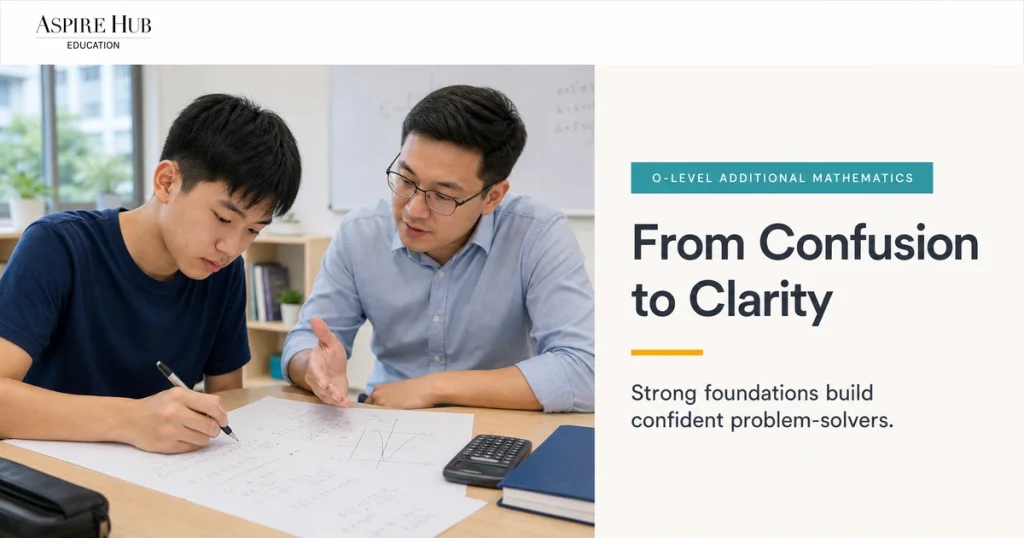
O-Level Additional Mathematics can be a demanding subject. Students must understand abstract concepts, connect ideas across different chapters and apply the correct methods accurately under examination conditions.
A student may follow a classroom example successfully but struggle when a question is presented differently. Once gaps appear in algebra, functions or trigonometry, later topics such as differentiation and integration can become considerably harder.
Our O Level A Math tuition programme provides Secondary 3 and Secondary 4 students with structured guidance, targeted practice and examination preparation. Lessons are designed to help students strengthen their foundations, understand difficult concepts and approach A Math questions with greater confidence.
Speak with us about your child’s current challenges and find a suitable class.
Is Your Child Finding O-Level A Math Difficult?
A Math involves much more than remembering formulas. Students must understand the concepts behind each question, identify the correct method and present their working clearly to earn both method and accuracy marks.
Your child may need additional support if they have difficulty with algebra, indices, surds or logarithms. They might understand examples demonstrated in class but struggle when questions are presented differently or combine several topics. Other warning signs include frequent careless mistakes, incomplete test papers, difficulty keeping up with school lessons and declining confidence in the subject.
These challenges do not mean that your child is “bad at mathematics.” They often arise because an earlier concept has not been fully understood or the student lacks a structured approach to solving unfamiliar questions.
With timely guidance and focused practice, students can close these learning gaps, rebuild their confidence and prepare more effectively for advanced A Math topics.
What Is O-Level Additional Mathematics?
O-Level Additional Mathematics—better known as A Math—is usually taken by selected Secondary 3 and Secondary 4 students in Singapore. Unlike subjects that can be managed mainly through memorisation, A Math requires students to understand mathematical relationships and apply them across increasingly complex problems.
The subject extends the algebra students encounter in earlier years and introduces more advanced areas such as functions, logarithms, trigonometry and calculus. Because its topics are closely connected, a weakness in one area can affect several others. A student who is not confident in algebraic manipulation, for example, may later struggle with functions, trigonometric equations and differentiation.
A Math does more than prepare students for one O-Level examination. It develops logical reasoning, precision and multi-step problem-solving skills. A strong foundation can also support students who intend to study mathematics-related subjects in junior college, polytechnic or other post-secondary programmes.
What Is the Difference Between A Math and E Math?
Although A Math and Elementary Mathematics commonly called E Math are both O-Level subjects, they have different objectives and are assessed through separate examinations.
E Math builds the essential mathematical knowledge students need for academic study and everyday applications. Its syllabus covers areas such as numbers, algebra, geometry, measurement, statistics and probability.
A Math takes students further into abstract mathematical reasoning. It places greater emphasis on recognising relationships, combining concepts and constructing multi-step solutions. Its syllabus includes more advanced algebra, functions, logarithms, trigonometry and calculus.
| Area | Additional Mathematics | Elementary Mathematics |
|---|---|---|
| Common name | A Math | E Math |
| Main purpose | Develop advanced mathematical reasoning and prepare students for higher-level mathematics | Build broad foundational and practical mathematical skills |
| Key areas | Advanced algebra, functions, logarithms, trigonometry and calculus | Numbers, algebra, geometry, measurement, statistics and probability |
| Question style | Often abstract, cumulative and multi-step | Focuses on applying core concepts across a broad syllabus |
| Assessment | Separate O-Level examination | Separate O-Level examination |
The most important distinction is not simply that A Math is “harder.” It requires a different way of thinking. Students must decide which concepts are relevant, connect knowledge from different topics and present a logically complete solution.
For this reason, A Math tuition should not be treated as general mathematics practice. An effective programme must address the specific Additional Mathematics syllabus, strengthen the algebraic foundations behind advanced topics and teach students how to approach unfamiliar questions with confidence.s support.
What Students Learn in O Level A Math Tuition
O-Level Additional Mathematics is a connected discipline. Algebra supports functions, functions provide the foundation for calculus, and trigonometry draws on both algebraic manipulation and graphical reasoning. When one of these foundations is weak, students may struggle across several chapters not just one topic.
Our programme follows the O-Level Additional Mathematics syllabus while responding to each student’s school progress and learning needs. Instead of teaching formulas as isolated procedures, lessons help students understand the relationships between topics, choose suitable methods and communicate their solutions accurately.
Algebra: The Foundation of A Math
Algebra is the working language of Additional Mathematics. Students must be able to transform expressions, solve equations and recognise mathematical structures before they can confidently handle more advanced topics.
Key areas covered: Quadratic functions and equations, polynomials, simultaneous equations, indices and surds, exponential and logarithmic functions, partial fractions, and binomial expansion.
Students are taught to understand why a method works and when it should be used. Particular attention is given to algebraic accuracy, since errors involving signs, brackets, indices or factorisation can affect an entire solution.
Learning outcome: Students become more fluent in algebraic manipulation and better prepared to solve unfamiliar, multi-step questions.
Functions and Graphs: Connecting Equations with Meaning
Functions describe how one quantity changes in relation to another. To master this area, students must understand both the algebraic form of a function and the information communicated by its graph.
Key areas covered: Functions, composite functions, inverse functions, exponential and logarithmic functions, graph transformations, coordinate geometry, straight lines and curves.
Lessons help students interpret intercepts, gradients, turning points and transformations instead of merely memorising the appearance of standard graphs. They also learn how changes to an equation affect the position and shape of its graph.
Learning outcome: Students can move confidently between equations and graphical representations, allowing them to analyse problems from more than one perspective.
Geometry and Trigonometry: Reasoning with Relationships
A Math trigonometry questions often require students to combine identities, equations and geometrical information within a single solution. Success therefore depends on method selection as much as formula knowledge.
Key areas covered: Trigonometric functions, identities and equations, radian measure, coordinate geometry and related applications.
Students learn how to identify relevant relationships, manipulate trigonometric expressions and solve equations within a specified range. They are also taught to verify their solutions and reject answers that do not satisfy the conditions of the question.
Learning outcome: Students develop a structured approach to trigonometry and can solve complex questions with greater accuracy.
Calculus: Understanding Change and Accumulation
Calculus is often one of the most unfamiliar parts of the A Math syllabus. It becomes much more accessible when students understand what differentiation and integration represent, rather than treating them as sets of rules.
Key areas covered: Differentiation, gradients, rates of change, stationary points, maximum and minimum problems, integration and areas under curves.
Lessons connect differentiation to gradients and changing quantities, while integration is introduced as accumulation and reverse differentiation. Students begin with fundamental techniques before progressing to applications and examination-style problems.
Learning outcome: Students can interpret calculus questions, select an appropriate process and apply it accurately in both routine and unfamiliar situations.
From Topic Knowledge to Examination Performance
Knowing each topic separately is not enough for the O-Level examination. Students must also recognise which concepts a question is testing, particularly when several topics appear together.
Our lessons therefore progress from concept development to guided examples, independent practice and mixed-topic examination questions. Students learn to:
- Identify the mathematical information provided
- Determine which concept or method is relevant
- Organise multi-step solutions logically
- Present sufficient working for method marks
- Check answers for algebraic and contextual accuracy
- Manage their time under examination conditions
This connected approach helps students build more than topic knowledge. It develops the reasoning, accuracy and adaptability required to handle O-Level A Math with confidence.pplications.
How Our O-Level A Math Tuition Works
Every student experiences A Math differently. Some have gaps in algebra that affect later topics, while others understand the syllabus but lose marks through careless errors, weak presentation or poor time management.
Our teaching process addresses the source of each difficulty before moving students towards independent examination performance.
A Structured Path from Learning Gaps to Exam Readiness
Effective A Math support begins with understanding why a student is struggling. Our teaching process moves from diagnosis and concept-building to independent application, examination performance and measurable progress.
01. Assess the Student’s Starting Point
We review the student’s recent results, schoolwork and problem-solving methods to identify where understanding begins to break down. A short diagnostic exercise may also be used to distinguish conceptual gaps from careless mistakes or examination-related difficulties.
This gives the tutor a clear starting point and ensures that lesson time is directed towards the areas with the greatest impact.
02. Rebuild the Right Foundations
A Math topics are highly connected. Difficulty with calculus, for example, may originate from an earlier weakness in algebra, indices or functions.
Tutors revisit only the prerequisite skills the student needs, helping them close important gaps without repeating material they have already mastered. This creates a stronger foundation for current and future topics.
03. Develop Genuine Understanding
Concepts are explained through logical steps, visual connections and carefully selected examples. Students learn what each method represents, why it works and how to recognise when it should be used.
By explaining their own reasoning and asking questions during the lesson, students can correct misconceptions before they develop into repeated errors.
04. Build Independent Problem-Solving Skills
Students progress from guided practice to independent, mixed-topic and examination-style questions. The difficulty increases gradually as their understanding, accuracy and confidence improve.
This progression trains students to analyse unfamiliar questions, connect relevant concepts and choose an appropriate solution method without depending on memorised templates.
05. Turn Feedback into Progress
Mistakes are reviewed according to their cause—whether they arise from weak understanding, an unsuitable method, an algebraic error, incomplete working or poor time management.
Tutors use these insights to plan subsequent lessons and help students avoid recurring errors. Regular assessments provide evidence of progress, while parent updates highlight improvements, continuing concerns and recommended next steps.
What Students Receive
The teaching process is supported by syllabus-aligned lessons, structured notes, worked examples and practice selected for each learning objective. As examinations approach, students also receive support with question interpretation, solution presentation, time management and revision planning.
In a class of no more than [maximum class size] students, tutors can observe each student’s problem-solving approach and provide focused guidance when needed.
SSupport That Matches Your Child’s Stage and Goals
A Math students do not all need the same type of support. A Secondary 3 student learning the fundamentals has different priorities from a Secondary 4 student preparing for the O-Levels. Even within the same level, one student may need to recover lost ground while another is working towards an A1.
Our programme considers both the student’s stage of study and their current performance when planning the appropriate support.
Support by School Level
Sec 3 A Math Tuition: Building the Right Foundation
For many students, Secondary 3 is their first experience with Additional Mathematics. The transition can feel significant: concepts become more abstract, algebra becomes more demanding and lessons may progress faster than students expect.
Our Sec 3 programme helps students understand new concepts from the beginning, develop accurate algebraic habits and keep pace with their school curriculum. Lessons also reinforce the connections between topics so students do not treat each method as an isolated formula.
The priority at this stage is to prevent small misunderstandings from becoming larger learning gaps. With a strong foundation, students are better prepared for advanced functions, trigonometry and calculus later in the syllabus.
Primary focus: Conceptual foundations, algebraic fluency, consistent school progress and effective study habits.
Sec 4 A Math Tuition: Moving Towards Exam Readiness
Secondary 4 requires students to balance new syllabus content with the revision of earlier topics. They must also learn how to connect concepts, solve questions efficiently and perform accurately under examination conditions.
Our Sec 4 programme helps students revisit weaker Sec 3 topics, consolidate the complete syllabus and progress towards mixed-topic and timed examination practice. Greater attention is given to question interpretation, solution presentation, speed and error reduction.
Students also receive guidance in organising their revision so that weaker areas are addressed early instead of being left until the final weeks before the examination.
Primary focus: Syllabus consolidation, examination application, time management and structured O-Level preparation.
Support by Learning Need
For Students Who Need to Catch Up
When a student is falling behind, immediately assigning difficult examination papers can create more confusion and frustration. Progress is more likely when the student first addresses the specific gaps affecting their current learning.
The tutor identifies these priority gaps and creates a manageable path forward. Essential concepts are revisited in the correct sequence before the student moves into more demanding applications.
The aim is not to rush through the syllabus. It is to help the student regain understanding, experience meaningful progress and become confident enough to attempt questions independently.
The pathway: Close essential gaps → rebuild confidence → return to school-level work → progress towards examination questions.
For Students Aiming for A1
Students targeting an A1 may already have a sound understanding of the syllabus. Their challenge is often achieving the precision, flexibility and consistency required to perform well across an entire examination paper.
Preparation focuses on unfamiliar and higher-order problems, mixed-topic applications and efficient solution methods. Timed practices help students improve their pacing, while detailed error analysis highlights recurring issues involving accuracy, interpretation or presentation.
Students are also taught to distinguish between a genuine knowledge gap and a preventable loss of marks. This allows their revision to become more focused and productive.
The pathway: Strengthen accuracy → tackle unfamiliar questions → improve examination efficiency → perform more consistently.
While no responsible tuition programme can guarantee a particular grade, focused teaching and purposeful practice can help every student make better use of their knowledge and work towards their strongest possible performance.
O-Level A Math Examination Preparation
Understanding the syllabus is only one part of preparing for O-Level A Math. Students must also recognise concepts without prompting, select efficient methods and complete their solutions accurately within a limited time.
Our examination preparation progresses from focused revision to full-paper practice, allowing students to develop both mathematical understanding and examination readiness.
Topical Revision
Topical revision allows students to strengthen one area at a time before dealing with questions that combine several concepts.
Students may work on focused sets covering algebra, functions, logarithms, trigonometry, differentiation or integration. This is particularly useful when revising a recently taught chapter or addressing a specific weakness identified through an assessment.
Topical practice is reviewed carefully so that students understand the reasoning behind each method instead of remembering only the answers.
Mixed-Topic A Math Practice
In the O-Level examination, questions do not always indicate which chapter or formula students should use. They must interpret the information and identify the relevant concept independently.
Mixed-topic practice removes the clues provided by chapter-based worksheets. It trains students to distinguish between possible methods, connect ideas from different parts of the syllabus and respond more confidently to unfamiliar questions.
O-Level A Math Past-Year Papers
O-Level A Math past-year papers help students become familiar with the standard, structure and demands of the national examination. They provide useful practice in interpreting question language, identifying common question formats and managing a complete paper.
Depending on the student’s stage of preparation, past-year questions may be used in several ways:
- Topical Ten-Year Series practice groups past O-Level questions by chapter, allowing students to strengthen a specific concept.
- Yearly Ten-Year Series practice presents complete papers by examination year, helping students practise paper management and topic selection.
- Selected past-year questions target a particular weakness, misconception or examination technique.
- Timed full-paper practice recreates examination conditions and tests whether the student can maintain accuracy throughout the paper.
Completing an O-Level A Math past-year paper is only the first step. Each attempt should be reviewed to identify inefficient methods, missing working, recurring errors and topics requiring further revision.
Secondary 3 A Math School Exam Papers
Secondary 3 A Math exam papers are useful for students who are still building their foundations. These papers generally focus on the topics taught during the first year of the Additional Mathematics course.
Appropriate school-paper practice can help Sec 3 students:
- Review topics covered in their school curriculum
- Prepare for weighted assessments and year-end examinations
- Experience different question styles
- Identify gaps before progressing to Sec 4
- Practise combining concepts taught across the year
The papers selected should match the student’s current syllabus coverage. Giving students questions based on topics they have not learned may create unnecessary confusion and provide an inaccurate picture of their progress.
Secondary 4 A Math Prelim Papers
A Math prelim papers expose Secondary 4 students to challenging questions from different Singapore schools. They are particularly useful after students have covered most of the syllabus and are ready for broader examination practice.
Sec 4 prelim-paper practice can help students:
- Encounter unfamiliar wording and question structures
- Apply concepts across several chapters
- Practise higher-order and multi-step problems
- Compare different solution approaches
- Improve accuracy under timed conditions
- Identify weaknesses before the O-Level examination
Prelim papers vary in style and difficulty. Tutors should therefore select questions according to the student’s learning objective rather than assuming that the most difficult paper will always produce the greatest improvement.
O-Level A Math Practice Papers and Mock Examinations
Practice papers provide additional opportunities to apply the complete syllabus. Well-designed mock examinations can simulate the demands of the O-Level paper while focusing on important concepts and common areas of difficulty.
Full and partial mock papers are used to assess:
- Question interpretation
- Choice of method
- Algebraic accuracy
- Quality of mathematical presentation
- Time allocation across sections
- Ability to check completed answers
- Performance across an extended paper
Mock examination results can then be used to guide the student’s next revision cycle.
Timed Practice and Paper Management
Some students understand the content but struggle to complete the paper. Timed exercises help them develop a realistic working pace and make better decisions when a question takes longer than expected.
Students learn how to allocate time, avoid becoming stuck on one problem and reserve sufficient time to check important steps. The objective is not simply to work faster, but to work efficiently without sacrificing accuracy.
Personalised Mistake Analysis
Every completed paper should produce more than a score. Students review their mistakes according to the reason marks were lost, such as:
- Incomplete conceptual understanding
- Incorrect choice of method
- Algebraic or sign errors
- Misreading the question
- Insufficient mathematical working
- Poor time allocation
- Failure to check the final answer
Patterns from past-year papers, prelim papers and mock examinations are recorded and used to prioritise subsequent revision. In this way, every mistake becomes a practical guide to what the student should improve next.
Meet Our O-Level A Math Coaches
Strong subject knowledge matters. But an effective A Math coach must also understand how a student thinks, where their learning begins to break down and what guidance will help them progress independently.
Aspire Hub’s O-Level A Math programme is led by trained, full-time coaches who guide Secondary 3 and Secondary 4 students through the demands of Additional Mathematics. Lessons are conducted in structured small groups, giving coaches the opportunity to observe each student’s problem-solving process and provide focused feedback.
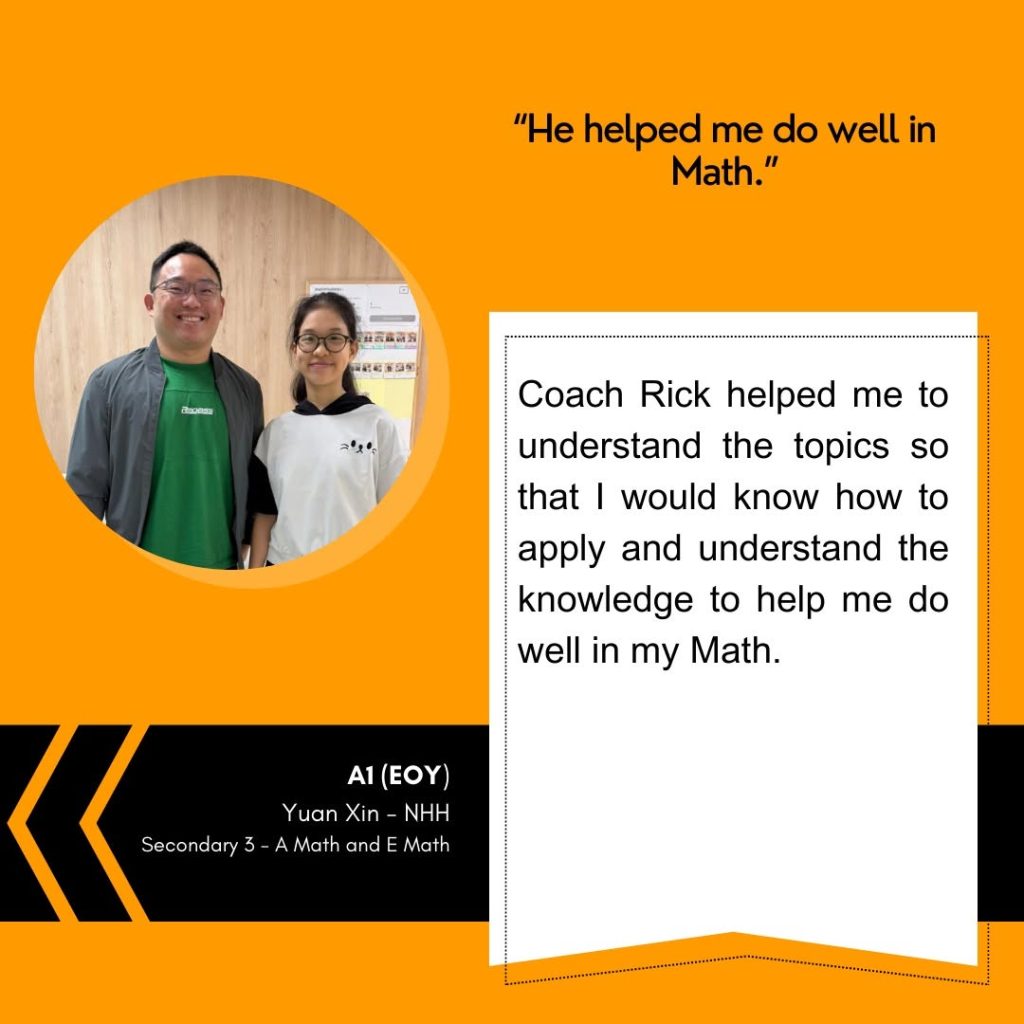
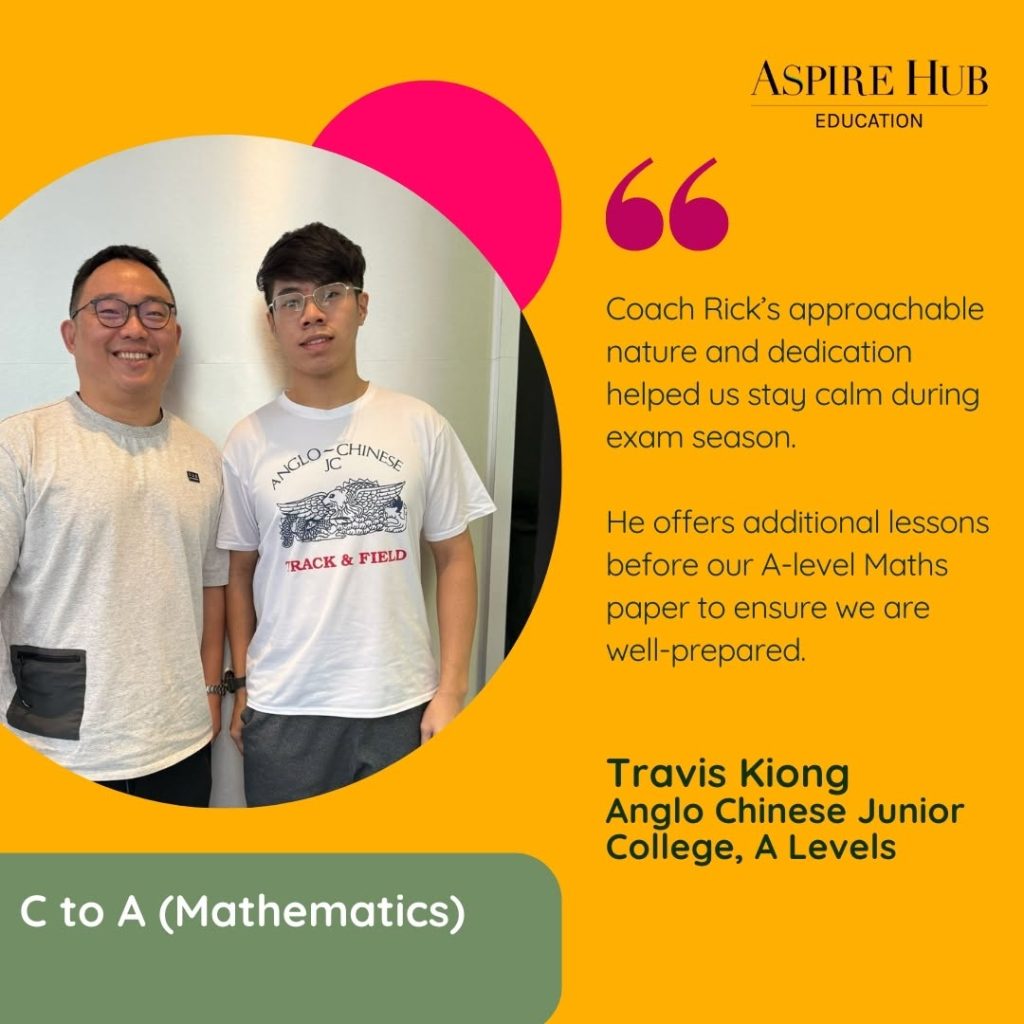
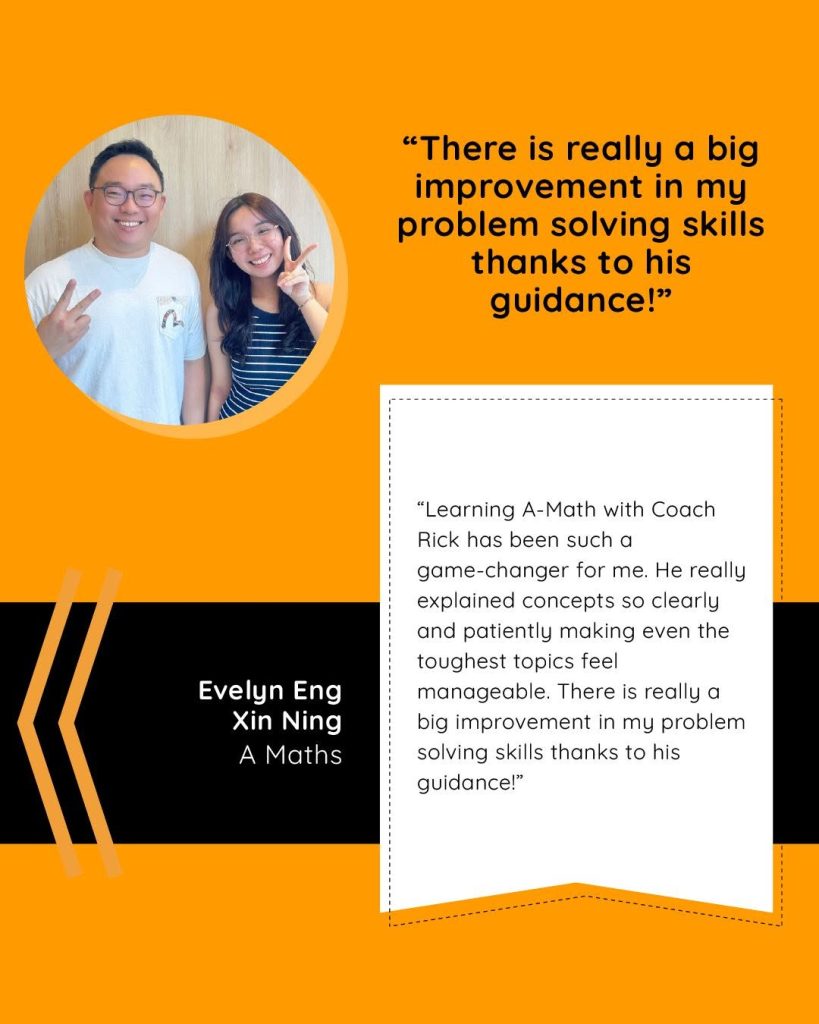
Our coaches do not simply demonstrate a method and ask students to repeat it. They help students understand why the method works, recognise when it should be applied and organise their working clearly under examination conditions.
Coaching That Responds to the Individual
Every student enters A Math with different strengths and challenges. Some need to rebuild their algebraic foundations. Others understand the syllabus but struggle with accuracy, time management or unfamiliar questions.
Through the Aspire Coaching Framework™, our coaches:
- Diagnose conceptual gaps and recurring misconceptions
- Clarify complex ideas through structured explanations
- Structure problem-solving and revision approaches
- Strengthen accuracy through purposeful practice and feedback
- Elevate examination strategy, precision and confidence
This allows each student to receive guidance that reflects their current level rather than following a one-size-fits-all learning path.
Understanding precedes memorisation. Structure precedes speed. Progress precedes pressure.
Small-Group A Math Coaching
Our small-group format combines active participation with individual guidance. With approximately 6 to 8 students per class, coaches can review students’ working, respond to questions and identify errors that may not be visible from the final answer alone.
Students benefit from:
- Clear explanations of difficult A Math concepts
- Opportunities to ask questions during the lesson
- Immediate correction of misconceptions
- Structured notes and guided practice
- Individual feedback on working and presentation
- Progress monitored according to their learning needs
The objective is not to create dependence on tuition. It is to equip students with the clarity, structure and confidence to solve problems more independently.
Find a Class That Fits Your Child
A suitable class should match more than the student’s available timing. It should also reflect their level, current performance and learning priorities.
Aspire Hub supports Secondary 3 and Secondary 4 A Math students across multiple locations in Singapore. Our team will consider your child’s learning needs and weekly commitments before recommending an appropriate class.
Depending on current availability, families may explore:
- Weekday and weekend classes
- Convenient branch locations
- In-person small-group coaching
- Live online learning options
- Sec 3 foundation-building classes
- Sec 4 O-Level preparation classes
- Trial-class arrangements
If your preferred timing is unavailable, our team will help you explore another suitable class, location or learning format.
Class Information at a Glance
| Programme detail | Information |
|---|---|
| Level | Secondary 3 and Secondary 4 |
| Subject | O-Level Additional Mathematics |
| Academic track | G3 / O-Level |
| Class format | Structured small-group coaching |
| Class size | Approximately 6 to 8 students |
| Lesson schedule | Weekday and weekend options, subject to availability |
| Learning mode | In-person and selected online options |
| Locations | Multiple Aspire Hub branches across Singapore |
| Teaching team | Trained, full-time Aspire Hub coaches |
| Curriculum | Aligned with the relevant MOE A Math syllabus |
| Trial class | Available by arrangement |
| Learning materials | Structured notes, guided practices and examination preparation materials |
O-Level A Math Tuition Fees
O Level A Math tuition fees start from $100+, depending on the class format, programme selected and lesson arrangement.
Before enrolment, our team will explain the applicable fees, class schedule and programme details clearly. Parents can also ask about trial-class arrangements, learning materials and the relevant enrolment terms before making a decision.
For the latest fee schedule, speak with our team and let us recommend an option based on your child’s level and learning needs.
Take the Next Step with Aspire Hub
The right support begins with understanding where your child is now and what they need to progress.
Speak with our team about your child’s current A Math performance, areas of difficulty and weekly availability. We will help you find a suitable class and explain what to expect from the programme.
We walk with you through every stage of your learning journey.
How Parents Can Choose the Right A Math Tuition Programme
The most popular or expensive programme is not automatically the most suitable one. Parents should consider how well a programme matches their child’s needs.
Check the tutor’s relevant experience
Ask whether the tutor regularly teaches O-Level Additional Mathematics and understands its syllabus, common misconceptions and examination requirements.
Understand the teaching method
A good programme should do more than provide worksheets. Find out how tutors explain concepts, diagnose mistakes and support students who do not understand a topic.
Consider class size
Smaller classes can make it easier for tutors to notice mistakes and answer individual questions. However, the quality of instruction and classroom management also matters.
Review the learning materials
Ask whether students receive structured notes, topical practices, worked solutions and examination preparation appropriate to their level.
Look for meaningful feedback
Regular feedback helps students understand what to improve and gives parents greater visibility into their child’s progress.
Compare the full cost
Consider lesson fees, registration charges, material fees and replacement-class policies. Parents should understand the total commitment before enrolling.
Involve your child
A student is more likely to benefit when the tutor’s communication style and class environment make it comfortable to ask questions and learn from mistakes.
How Parents Can Choose the Right A Math Tuition Programme
The most popular or expensive programme is not automatically the most suitable one. Parents should consider how well a programme matches their child’s needs.
Check the tutor’s relevant experience
Ask whether the tutor regularly teaches O-Level Additional Mathematics and understands its syllabus, common misconceptions and examination requirements.
Understand the teaching method
A good programme should do more than provide worksheets. Find out how tutors explain concepts, diagnose mistakes and support students who do not understand a topic.
Consider class size
Smaller classes can make it easier for tutors to notice mistakes and answer individual questions. However, the quality of instruction and classroom management also matters.
Review the learning materials
Ask whether students receive structured notes, topical practices, worked solutions and examination preparation appropriate to their level.
Look for meaningful feedback
Regular feedback helps students understand what to improve and gives parents greater visibility into their child’s progress.
Compare the full cost
Consider lesson fees, registration charges, material fees and replacement-class policies. Parents should understand the total commitment before enrolling.
Involve your child
A student is more likely to benefit when the tutor’s communication style and class environment make it comfortable to ask questions and learn from mistakes.
FAQ: O-Level A Math Tuition
Have a question about O-Level A Math tuition? Tap a question to expand it.
A Math and E Math are separate O-Level subjects with different syllabuses and examinations.
E Math develops broad mathematical foundations across algebra, geometry, statistics and practical applications. A Math extends students into more advanced algebra, functions, trigonometry and calculus. Students taking both subjects must prepare for two distinct examinations.
O-Level A Math can be challenging because its topics are abstract, interconnected and cumulative.
A weakness in algebra may later affect a student’s ability to manage functions, trigonometry and calculus. The subject becomes more manageable when concepts are learned in the correct sequence and reinforced through structured, progressively challenging practice.
O-Level A Math tuition generally covers advanced algebra, quadratic functions, polynomials, indices, surds, logarithms, binomial expansion, functions, coordinate geometry, trigonometry and calculus.
Lessons should follow the relevant MOE Additional Mathematics syllabus while responding to the topics taught in the student’s school.
Yes. Sec 3 A Math tuition focuses on establishing algebraic fluency, understanding new concepts and preventing early learning gaps.
Sec 4 A Math tuition places greater emphasis on syllabus consolidation, mixed-topic practice, examination techniques and O-Level preparation. The lesson priorities should reflect the student’s stage and current performance.
Consider additional support when your child consistently struggles with schoolwork, falls behind the class pace or begins losing confidence in A Math.
Students do not need to wait until their grades decline significantly. Sec 3 support can prevent foundational gaps, while Sec 4 tuition can strengthen weaker topics and prepare students for the O-Level examination.
Yes. Effective A Math tuition should first identify which foundational gaps are affecting the student’s current work.
A student struggling with calculus, for example, may need to strengthen algebra, indices or functions. At Aspire Hub, coaching begins by diagnosing these gaps before clarifying concepts and progressing towards more demanding applications.
A Math tuition can help higher-performing students improve their precision, flexibility and examination consistency.
Preparation may include unfamiliar problems, mixed-topic questions, timed papers and detailed error analysis. However, no responsible programme should guarantee an A1, as results also depend on the student’s starting point, effort, attendance and independent revision.
Yes. Aspire Hub’s Secondary Mathematics programme follows the relevant MOE syllabus and supports Sec 3 and Sec 4 students preparing for the O-Level pathway.
Lessons develop conceptual understanding, structured problem-solving and examination technique rather than relying only on formula memorisation or repetitive drilling.
A Math examination preparation may include topical Ten-Year Series questions, yearly O-Level A Math past-year papers, Secondary 3 school papers and Secondary 4 prelim papers.
The materials used should match the student’s syllabus coverage and learning objective. Each paper should be reviewed carefully so that mistakes guide the next stage of revision.
Most students benefit from one regular coaching session each week, supported by consistent revision between lessons.
The appropriate arrangement depends on the student’s foundations, examination timeline and academic goals. Students approaching an examination may also benefit from targeted revision, mock papers or additional timed practice where available.
Aspire Hub conducts structured small-group coaching, with classes generally limited to approximately six to eight students.
This format allows coaches to observe how students solve problems, correct misconceptions and provide more focused feedback than would usually be possible in a large lecture-style class.
Aspire Hub coaches monitor each student’s understanding through lesson performance, completed work, targeted exercises and assessments.
Recurring mistakes are used to identify what requires further attention. The focus is on measurable progress: correcting misconceptions, strengthening foundations and helping students apply their knowledge more independently.
Aspire Hub provides live online learning options for secondary students, subject to programme and class availability.
Online lessons allow students to learn from home while continuing to receive real-time instruction in a scheduled class. Parents should contact the team to confirm whether an appropriate O-Level A Math online class is currently available.
Aspire Hub’s O-Level A Math tuition fees start from $100+, depending on the programme, lesson format and class arrangement selected.
Parents should request the current fee schedule and confirm the billing period, learning-material charges and applicable enrolment terms before registering.
Yes. Parents can request a trial class to let their child experience Aspire Hub’s coaching approach before committing to a programme.
The team will help identify an appropriate branch, level and class based on current availability. Trial-class fees, promotions and conditions should be confirmed when making the booking.
A trial class may begin with a brief assessment of the student’s strengths and learning gaps before they participate in a coaching session.
This gives the student an opportunity to experience the teaching approach and allows the coach to recommend suitable learning priorities and next steps.
Aspire Hub operates 15 branches across Singapore, with locations in the central, eastern, western, north-eastern and northern regions.
Many branches are situated in or near MRT-accessible shopping centres. A Math availability differs by branch, so parents should check the current schedule before selecting a location.
Share your child’s level, current performance, preferred location and weekly availability with Aspire Hub.
The team can then identify an appropriate A Math programme and recommend available class timings. If the first choice is unavailable, they can help explore another branch, schedule or learning format.
Start by submitting an enquiry or requesting a trial class.
Aspire Hub’s team will contact you to understand your child’s needs, recommend a suitable branch and programme, and explain the schedule and fees. You can also contact Aspire Hub at +65 9821 6612 or enquiries@aspirehub.com.
Help Your Child Approach A Math with Greater Confidence
Difficulty with A Math does not need to become a permanent barrier.
When students understand the concepts behind each method, practise at an appropriate level and learn from their mistakes, they can approach the subject with greater clarity and confidence.
Our O-Level A Math tuition programme supports Secondary 3 and Secondary 4 students through structured explanations, targeted practice and focused examination preparation.
Speak with our team about:
- Your child’s current results and challenges
- Topics they find most difficult
- Their school and examination timeline
- Suitable classes and available schedules
- Programme fees and trial options
Let us recommend an appropriate next step for your child’s O-Level A Math journey.