“I heard the answer—but I still chose the wrong option.”
Many students have this experience with PSLE Listening Comprehension. They understand the recording, yet lose marks because two options sound possible, an important detail passes too quickly or the speaker’s meaning is implied rather than stated directly.
This is why simply telling a child to “listen more carefully” rarely solves the problem. students need to know how to preview the options, recognise what the question is testing and use the two readings differently.
In this guide, we break that process down clearly. Drawing on the structured skills developed through our Primary English Programme at Aspire Hub, we explain what the paper assesses, where pupils commonly lose marks and how your child can listen with a clear purpose instead of relying on memory or guesswork.
Understanding the PSLE Listening Comprehension Paper
PSLE Listening Comprehension is Paper 3 of the English Language examination. It assesses whether students can understand spoken English at the literal, inferential and evaluative levels—not simply whether they can remember the words they hear.
What Will Students Hear in the Examination?
According to the official 2026 PSLE English Language syllabus, the paper may include spoken texts that recount, entertain, instruct, describe, inform, explain, respond, argue, evaluate or persuade.
In practical terms, students may hear:
- Conversations
- Announcements
- Instructions
- Explanations
- Informative passages
- Persuasive messages
- Stories and personal accounts
Each type of audio requires a slightly different listening approach. Your child may need to identify a specific detail in an announcement, for example, but interpret a speaker’s feelings or intentions in a story.
PSLE Listening Comprehension Format at a Glance
| Feature | PSLE English Paper 3 |
|---|---|
| Component | Listening Comprehension |
| Question type | Multiple-choice questions |
| Number of questions | 20 |
| Total marks | 20 |
| Weighting | 10% of the English result |
| Duration | Approximately 35 minutes |
| Picture-based questions | First seven items |
| Number of readings | Each text is read twice |
| Preview time | Given before the first reading |
How Is the Paper Structured?
The first seven questions use graphic representations. Students must listen for details that distinguish one picture from another, such as an action, location, object or sequence of events.
For the remaining questions, students select their answers by connecting information from the spoken texts with the written options provided.
Although the paper contributes 10% of the overall English result, these 20 marks should not be overlooked. Learning how to preview the options, listen with a clear purpose and use the second reading effectively can help your child avoid preventable mistakes.
What Does PSLE Listening Comprehension Assess?
The paper assesses four core skills. A student may understand the recording generally but still lose marks if one of these skills is weak.
| Core skill | What students need to do | Where marks are commonly lost |
|---|---|---|
| Understand the main message | Recognise what the recording is mainly communicating | Choosing a true detail that does not represent the main point |
| Track important details | Identify relevant people, places, times, reasons and changes in plan | Missing words such as “but”, “instead” or “finally” |
| Interpret meaning | Use context and tone to understand purpose, attitude or implied meaning | Making an assumption that is not supported by the recording |
| Choose accurately | Compare visual or written options and select the best-supported answer | Selecting a distractor because it repeats familiar words |
Together, these skills help students move from simply hearing the recording to understanding it and answering with evidence.
Why Students Lose Marks in Listening Comprehension
Listening mistakes are rarely random. In many cases, students understand the general meaning of the recording but lose marks because they are unsure what to focus on, miss a change in information or choose an option that only sounds correct.
| What goes wrong | What it looks like during the paper | What students should do instead |
|---|---|---|
| Listening without a clear target | The student tries to absorb every word and becomes overwhelmed | Preview the question and identify whether they need to listen for a reason, action, feeling, location or outcome |
| Following familiar words | An option is chosen because it repeats a phrase from the recording | Compare the full meaning of the option with the question |
| Missing a change or correction | The student remembers the original plan but overlooks what was decided later | Listen closely for turning words such as “but”, “however”, “instead” and “finally” |
| Dwelling on a missed phrase | The student keeps replaying one sentence mentally and misses what follows | Let the missed phrase go, regain focus and use the second reading to confirm the answer |
| Taking excessive notes | Attention shifts from the recording to writing complete sentences | Note only essential keywords, numbers or short symbols |
| Using both readings in the same way | The student listens passively twice without becoming more certain | Use the first reading to understand the situation and the second to verify the decisive detail |
The score alone does not reveal which of these problems a student is facing. Reviewing the reason behind each incorrect answer makes practice more focused and helps prevent the same mistake from appearing again.
A Five-Step Strategy for PSLE Listening Comprehension
Once students understand where marks are commonly lost, they need a method they can follow during the examination. The five steps below give each stage of listening a clear purpose.
1. Preview the Question
Use the time provided before each text to read the question and compare every option.
Students should identify what they need to find: a person, reason, location, action, feeling or outcome. For picture-based questions, they should notice the differences between the images before the recording begins.
The goal is to listen with a target rather than wait for something familiar to appear.
2. Predict the Information Needed
Prediction does not mean guessing the answer. It means recognising the type of information that would answer the question.
If the question asks why someone was late, the student should listen for a cause. If it asks how a speaker feels, tone and word choice become more important than factual details.
This small step helps direct attention towards the right clues.
3. Use the First Reading to Understand
During the first reading, students should build an overall picture of the situation.
Who is speaking? What is happening? What is the main message? Has a plan changed? How does the speaker feel?
Students should avoid panicking over one unfamiliar word. The surrounding context may still provide enough information to understand the passage.
4. Use the Second Reading to Confirm
The second reading should have a different purpose. Instead of listening to the whole passage in the same way again, students should confirm the detail that separates the possible answers.
This may be a reason, a change in plan, a sequence of events or a shift in the speaker’s attitude.
If two options still appear possible, students should listen for the evidence that supports one and rules out the other.
5. Check the Complete Meaning
Before finalising the answer, students should ask:
Does this option answer the exact question, or does it merely repeat something I heard?
An option can contain true information from the recording and still be incorrect. The best answer must be fully supported and respond directly to what was asked.
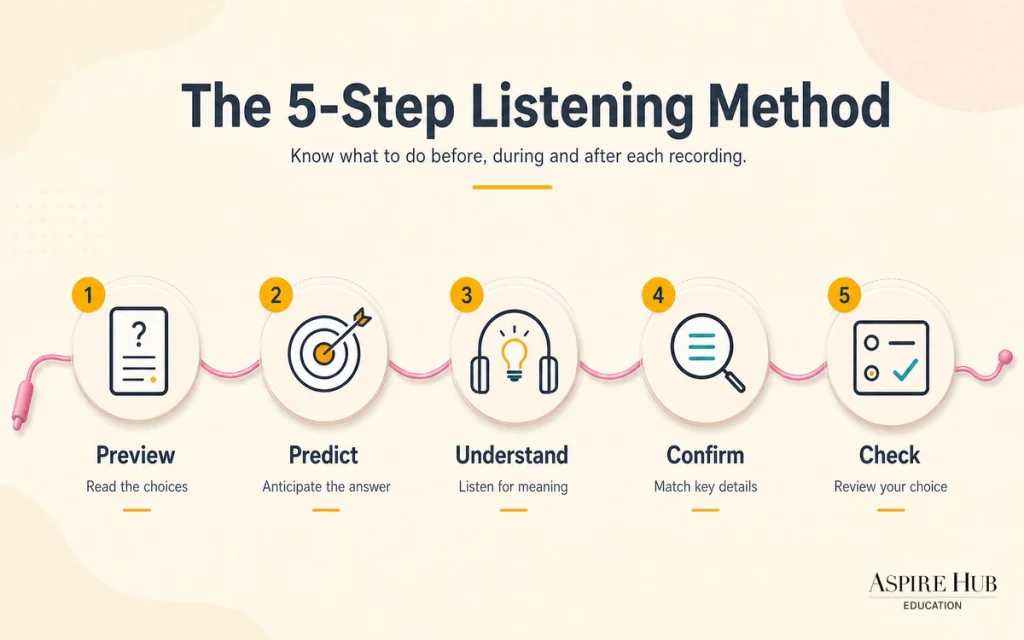
The complete method is:
Preview → Predict → Understand → Confirm → Check
With regular practice, these steps become a natural listening routine rather than five separate actions students must consciously remember.
How to Practise PSLE Listening Comprehension Effectively
A focused 20-minute practice session, completed two or three times a week, is usually more valuable than a long exercise completed without careful review.
The 20-Minute Listening Routine
Minutes 1–3 — Set a Listening Target
Read the questions and identify what information is required. It may be a reason, action, sequence, feeling or final decision.
For picture-based questions, compare the options and notice the visual differences before playing the audio.
Minutes 4–10 — Listen Twice
Use the first reading to understand the situation and main message. Use the second to confirm the specific detail needed for each answer.
Listening with a different purpose each time prevents the second reading from becoming passive repetition.
Minutes 11–15 — Answer With Evidence
Select an option and identify the words, tone or context that support it.
If students cannot explain why an answer is correct, they may have relied on familiar wording or guesswork rather than evidence.
Minutes 16–20 — Review the Mistake
For every incorrect answer, identify what went wrong. The student may have missed a detail, misunderstood the question, followed a distractor or overlooked a change in tone.
Record the reason briefly so that recurring weaknesses become easier to recognise.
Vary the Focus During the Week
Use one session for picture-based and factual questions, another for main ideas and inference, and a third for timed practice.
Include different spoken texts such as conversations, announcements, instructions, interviews, news reports and short stories. The aim is to improve one listening habit at a time—not simply to complete more exercises.
Where to Find Past PSLE Listening Comprehension Papers
If you have been looking for PSLE Listening Comprehension materials from 2017, 2020, 2021, 2022, 2023 or 2024, older papers can still provide useful practice. However, they should be used to develop listening skills rather than predict the next examination.
Begin With the Current Format
The PSLE English format can change over time. An older paper may contain useful questions without matching the structure students will face today.
The best starting point is the official PSLE Listening Comprehension specimen paper, which reflects the format effective from 2025. Older materials can then be used as additional practice alongside it.
Use Past Papers to Identify Patterns
A past paper offers more than a final score. It can reveal whether a student repeatedly misses changes in information, struggles with inference or selects options containing familiar words.
After each exercise, review the reason behind every incorrect answer. The objective is to find patterns that can guide the next practice session.
Choose Reliable and Authorised Sources
PSLE questions and audio recordings may be protected by copyright. Avoid downloading or reproducing examination materials from sources that do not have permission to distribute them.
Parents can obtain materials through their child’s school, authorised educational publishers and SEAB’s list of official distributors of PSLE past-year papers.
Past-year practice is most valuable when students use it to improve how they listen and reason—not when they memorise answers or expect the next paper to follow the same pattern.
How Parents Can Support Listening Practice at Home
It can be frustrating to watch your child understand a recording, hesitate between two options and then lose a mark. Your first instinct may be to correct the answer immediately or ask them to listen more carefully.
However, the most helpful support often begins by making it safe for your child to explain what they heard—even when their answer is wrong.
Keep Practice Light and Natural
Home practice does not need to feel like another lesson. A short programme, story, announcement or conversation can become a listening activity without turning family time into a test.
Ask one or two thoughtful questions instead of questioning every detail:
“What do you think the speaker was trying to say?”
“Which part helped you decide?”
“Did anything change during the conversation?”
These questions encourage your child to think about meaning rather than search for the answer they believe an adult wants.
Be Curious About the Mistake
When an answer is incorrect, begin with:
“What did you hear that made you choose this?”
Your child’s explanation may reveal that they missed a change in plan, misunderstood the tone or selected an option containing familiar words. Once you understand the reason, you can guide them towards a better listening approach.
A mistake becomes much less discouraging when it leads to a clear next step.
Protect Your Child’s Confidence
Listening requires concentration, and pressure can make that concentration harder. If your child misses part of a recording, reassure them that they do not need to understand every word to find the answer.
Praise the process when they compare the options carefully, explain their reasoning or notice a mistake independently. These small improvements are signs that stronger listening habits are developing.
Build Stamina Gradually
If maintaining focus is difficult, begin with a short recording and one clear task. Increase the length only when your child can listen without becoming overwhelmed.
The goal is not to make home feel like an examination hall. It is to give your child a calm place to practise, make mistakes and become more confident with every attempt.
Exam-day guide
Examination-day checklist
1Before the paper
- ✓Arrive rested and ready to concentrate
- ✓Prepare the required stationery, including a 2B pencil
- ✓Listen carefully to all instructions
- ✓Use the preview time fully
2During the paper
- ✓Read the question before examining the options
- ✓Underline important qualifying words
- ✓Compare picture details carefully
- ✓Use the first reading to understand the overall meaning
- ✓Use the second reading to confirm specific information
- ✓Move on calmly if one phrase is missed
- ✓Avoid changing answers without clear evidence
- ✓Check that every response is shaded correctly
Coaching insight
How Aspire Hub helps pupils improve listening comprehension
Two pupils can obtain the same Listening Comprehension score for very different reasons. One may struggle with vocabulary, while another understands the words but misses important details or falls for distractors.
Effective preparation therefore begins by identifying the source of each pupil’s difficulty.
At Aspire Hub
Coaching can help pupils:
- ✓Recognise their recurring listening mistakes
- ✓Preview questions more purposefully
- ✓Distinguish main ideas from supporting details
- ✓Interpret tone, purpose and implied meaning
- ✓Eliminate misleading answer options
- ✓Practise with varied spoken-text formats
- ✓Build concentration under timed conditions
- ✓Review progress and adjust the learning focus
The goal is not only to improve performance in one paper. It is to develop attentive, thoughtful listeners who can understand spoken information and respond confidently.
FAQ: PSLE Listening Comprehension
Have a question about PSLE Listening Comprehension? Tap a question to expand it.
The current paper contains 20 multiple-choice questions, carrying a total of 20 marks.
The first seven questions are picture-based, where pupils choose the image that matches what they hear. The remaining questions ask pupils to select the written option that best matches the spoken text.
The paper takes approximately 35 minutes.
This includes the preview time given before each recording, so pupils have a short window to read the question and compare the options before listening begins.
It tests whether pupils can understand spoken English at the literal, inferential and evaluative levels, not simply whether they can remember the words they hear.
This means recognising the main message, tracking important details, interpreting tone or implied meaning, and choosing the option that is fully supported by the recording rather than one that only sounds familiar.
Yes. Under the current PSLE English format, each text is read twice, and pupils are given time to read the questions before the first reading.
The two readings work best when used differently: the first to understand the overall situation, and the second to confirm the specific detail that separates the answer options.
Listening Comprehension contributes 10% of the overall PSLE English Language result.
Although it is a smaller weighting compared to other papers, these 20 marks are made up of avoidable mistakes as often as genuine gaps in understanding, which makes focused practice worthwhile.
This usually happens because the student is unsure what to focus on, misses a change in information, or picks an option that only repeats familiar wording.
Common causes include listening without a clear target, dwelling on one missed phrase instead of moving on, and using both readings the same way instead of using the second one to confirm the decisive detail.
A five-step approach works well: preview the question, predict the type of information needed, use the first reading to understand the situation, use the second to confirm the decisive detail, and check that the chosen option fully answers the question.
With regular practice, this becomes a natural listening routine rather than five separate steps to remember consciously.
Begin with short recordings and give the pupil a clear listening purpose, such as identifying the main idea or three important details.
Increase the length and complexity gradually as their concentration improves, and vary the type of spoken text used so they build stamina across conversations, announcements and stories rather than just one format.
Short notes can help with names, numbers, reasons and sequences.
However, writing full sentences may distract pupils from the recording itself, so notes should be limited to essential keywords or short symbols rather than complete thoughts.
The first reading should be used to build an overall picture: who is speaking, what is happening, and how the speaker feels.
The second reading should have a narrower purpose: confirming the specific detail, such as a reason, change in plan or shift in attitude, that separates the possible answers. Listening to both readings the same way often leads to passive repetition rather than more certainty.
Start with official specimen materials, school resources and publications from authorised past-year paper distributors.
Make sure any older materials are checked against the latest examination format before use, since papers from before 2025 may not reflect the current structure.
The pupil should regain focus immediately, instead of continuing to think about the missed phrase.
The surrounding context and second reading may still provide enough information to answer the question, so dwelling on the gap usually costs more marks than the original miss.
Keep practice light: a short programme, story or conversation can become a listening activity without turning family time into a test.
When an answer is wrong, ask what the child heard that led to that choice rather than correcting it immediately. Their explanation usually reveals whether they missed a detail, misread the tone, or followed a distractor, which makes the next practice session more focused.
Help Your Child Listen With Greater Confidence
Students do not need to remember every word or understand a recording perfectly to perform well. What they need is a dependable method that helps them stay focused and recognise the information that matters.
By learning to preview, predict, understand, confirm and check, your child can approach each question with a clearer sense of what to do. The paper gradually becomes less about hoping to hear the answer and more about listening for evidence.
Progress may begin with something small: noticing a change in tone, recovering calmly after missing a phrase or explaining why one option is better than another. These moments show that stronger listening habits are taking shape.
With consistent practice, thoughtful review and patient support, every mistake can become a useful clue—and every practice session can help your child move towards PSLE with greater confidence.
Aspire Hub’s Primary Program supports these skills through structured practice, focused review and guidance suited to each pupil’s learning needs. Contact our education team to understand what may be affecting your child’s performance and how we can support their PSLE preparation.