Three pictures. One broad topic. And a limited amount of time to turn them into a story worth reading.
That is the real challenge behind PSLE English composition topics. Pupils are not simply tested on whether they can write grammatically correct sentences. They must interpret an unfamiliar topic, choose a useful picture prompt and shape their ideas into a coherent story with a clear direction, developed conflict and convincing resolution.
The first idea is not always the strongest one. A familiar picture may lead to a predictable plot. An exciting opening may have little connection to the topic. A memorised model composition may contain impressive language but become awkward once it is forced into a question it was never written to answer.
Strong composition writing therefore begins before the first paragraph. It begins with knowing how to read the topic, evaluate possible story ideas and select the one that offers both relevance and room for development.
By examining past PSLE English composition topics from 2015 to 2025, this guide reveals the themes and storytelling demands that appear repeatedly. It also shows pupils how to approach new prompts with greater flexibility, develop purposeful plots and prepare more effectively for PSLE 2026.
Past PSLE English Composition Topics from 2015 to 2025
Past PSLE English composition topics are broad by design. Titles such as “A Promise” or “A Long Wait” do not provide a ready made plot. Pupils must decide who is involved, what creates the central problem and why the experience matters.
Each question also includes two planning points. These are not additional questions that pupils must answer separately. They indicate the essential content that a relevant composition should develop. Looking at both the title and the planning points therefore gives a more accurate understanding of what each question tests.
| Year | Composition topic | Planning points in the question | What the composition needs to develop |
|---|---|---|---|
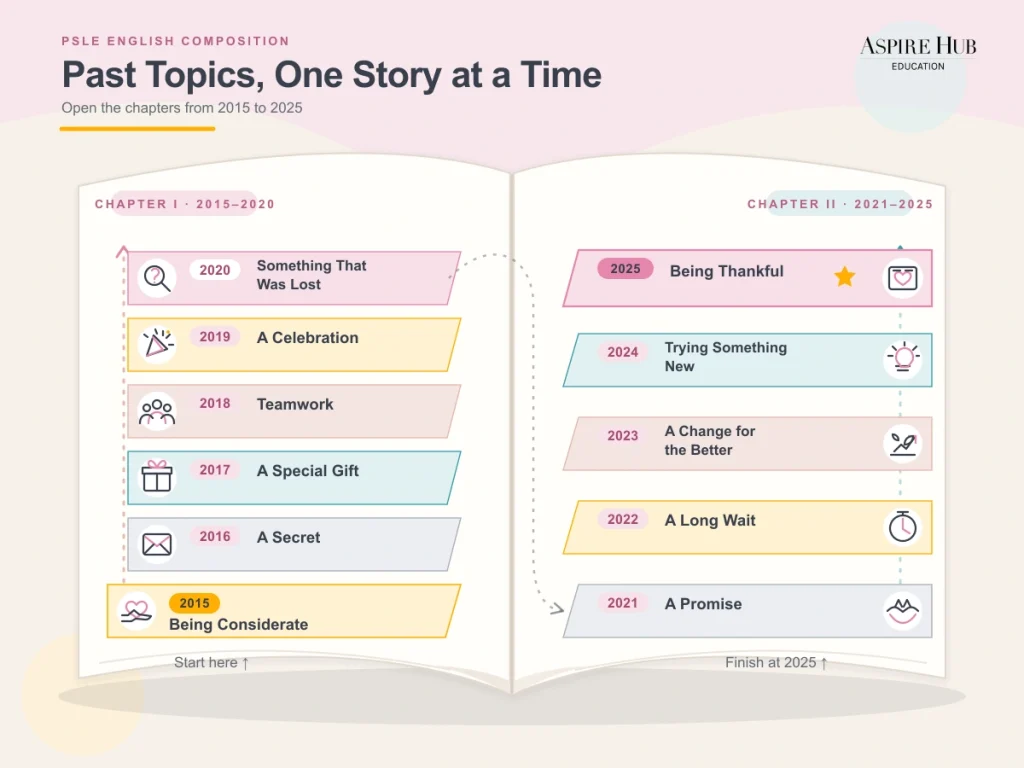
| 2025 | Being Thankful | Who was thankful? How was thankfulness expressed? | A clear reason for the gratitude and a convincing response through words, actions or a change in behaviour |
| 2024 | Trying Something New | What was the new experience? How did it turn out? | The uncertainty surrounding an unfamiliar experience, followed by a meaningful outcome |
| 2023 | A Change for the Better | What was the change? Why was it for the better? | A noticeable difference between the situation before and after the change, including why the outcome was an improvement |
| 2022 | A Long Wait | What was the wait about? What happened in the end? | A reason the wait matters, the tension created by the delay and an outcome that makes the experience significant |
| 2021 | A Promise | What was the promise? Was the promise kept? | The importance of the commitment, the difficulty involved in keeping it and the consequences of the final decision |
| 2020 | Something That Was Lost | How did it get lost? Was it found? | The circumstances surrounding the loss, its effect on the people involved and the eventual outcome |
| 2019 | A Celebration | What was the reason for the celebration? How was the occasion celebrated? | More than a description of a party. The story needs a meaningful reason for the occasion and events that give it narrative direction |
| 2018 | Teamwork | How did the team members work together? What did they hope to achieve? | A shared objective, individual contributions and a problem that requires genuine cooperation |
| 2017 | A Special Gift | What was the gift? Why was it special? | The personal meaning of the gift rather than its price or appearance alone |
| 2016 | A Secret | What was the secret? Why was it kept? | A credible reason for secrecy, the pressure it creates and the effect of keeping or revealing it |
| 2015 | Being Considerate | Who was considerate? How did the person act considerately? | Awareness of another person’s needs, followed by a thoughtful action that has a clear effect |
The topics and planning points above have been compiled from past PSLE English Paper 1 questions. Under the current format, pupils must write a composition of at least 150 words on a given topic and base it on at least one of three picture prompts. The pictures offer different ways to interpret the topic, while pupils are responsible for developing a relevant and coherent storyline. Parents and pupils can view the current requirements on the official 2026 PSLE examination formats page published by SEAB.
The picture choices also show how one topic can support very different stories. For “Trying Something New” in 2024, the pictures showed a CCA open house, a sandwich and a picnic tent. In 2025, “Being Thankful” was accompanied by a class party, a sunflower and a priority seating sign. None of these pictures provides a complete plot. Each merely opens a possible route into the topic.
This distinction is important. A pupil using the priority seating sign could write about giving up a seat, receiving help from another commuter or realising the needs of an elderly family member. The picture establishes a situation, but the writer still has to create the characters, conflict and emotional significance.
Past topics also show that PSLE Continuous Writing regularly tests more than event narration. Most questions require some form of cause and consequence:
- What caused the character to make a particular choice?
- What made the situation difficult?
- How did the character respond?
- What changed as a result?
Consider “A Promise”. A basic response may show a character making and keeping a promise. A more developed composition explains why the promise matters, introduces a situation that makes it difficult to keep, and shows the consequences of the character’s decision. The difference lies not in having a more complicated plot, but in developing the topic with greater depth.
Past PSLE English composition topics are therefore most useful when pupils study the thinking behind them. The goal is not to prepare eleven stories for eleven titles. It is to practise recognising the central demand of a question and developing a focused narrative that remains relevant from beginning to end.
What Past PSLE Composition Topics Reveal
Past PSLE English composition topics often begin with an ordinary situation, but the real focus is usually how a character responds when that situation becomes difficult, uncertain or emotionally significant.
| Recurring theme | Relevant past topics | What the story needs to show |
|---|---|---|
| Personal growth | Trying Something New, A Change for the Better | A challenge that leads to a believable change |
| Relationships and responsibility | A Promise, Teamwork, Being Considerate | How one person’s actions affect another |
| Values expressed through action | Being Thankful, A Special Gift, A Secret | Gratitude, honesty or kindness demonstrated through meaningful behaviour |
| Problems and consequences | Something That Was Lost, A Long Wait | A disruption that creates pressure and leads to consequences |
| Meaningful experiences | A Celebration, Trying Something New | Why an ordinary event becomes important to the character |
Across these themes, strong plots usually follow the same underlying movement:
Situation → pressure → decision → consequence
The pressure does not need to be dramatic. It may come from keeping a difficult promise, admitting a mistake or attempting something unfamiliar. What matters is that the character must make a meaningful choice and that the outcome connects clearly to the topic.
Recognising this pattern helps pupils move beyond simply describing what happened. It encourages them to build stories around decisions, consequences and believable character development.
Understanding the PSLE Continuous Writing Task
PSLE English Paper 1 consists of Situational Writing and Continuous Writing. Pupils have 1 hour and 10 minutes to complete both components and may manage the time between them.
| Paper 1 requirement | Current format |
|---|---|
| Total marks | 50 marks |
| Situational Writing | 14 marks |
| Continuous Writing | 36 marks |
| Minimum composition length | 150 words |
| Topic | One given topic |
| Visual prompts | Three pictures offering different interpretations |
| Picture requirement | The composition must use at least one picture |
This format has been used since the 2025 PSLE. For Continuous Writing, pupils must generate relevant ideas, organise them coherently and express them using accurate and appropriate vocabulary, grammar, punctuation and spelling. The full requirements are available through the official 2026 PSLE examination formats page published by SEAB.
The 150 word requirement is a minimum, not a recommended target or a measure of quality. A longer composition will not automatically receive more marks. Pupils still need sufficient development, clear organisation and a response that remains relevant to the topic and selected picture.
Writing far beyond what can be controlled within the available time may also create problems. It leaves less time to complete Situational Writing, review the plot and correct language errors. The aim is therefore not to produce the longest possible story, but to develop a complete and accurate one.
How to Analyse PSLE Composition Topics and Pictures
The pictures do not provide three ready made stories. They provide three possible ways to interpret the same topic. Pupils must decide which picture gives them the strongest connection to the topic and enough material for a complete narrative.
The topic should always come first. Choosing a picture before understanding the topic often leads to a story that includes the visual prompt but does not fully answer the question.
A useful planning framework is:
Topic demand + picture connection + central conflict + meaningful outcome = focused composition
1. Identify what the topic requires
Do not treat the title as a general theme. Translate it into something the story must demonstrate.
For “Being Thankful”, the composition needs to establish:
- Who feels thankful
- What caused the gratitude
- How that gratitude is expressed
A character saying “thank you” is not enough on its own. The story should give the gratitude a clear cause and show why the response matters.
2. Examine the possibilities behind each picture
The reported picture prompts for the 2025 topic “Being Thankful” were a class party, a sunflower and a priority seating sign.
The priority seating sign could lead to several different situations. A pupil might write about an elderly commuter receiving help, a tired caregiver being offered a seat or a child beginning to appreciate a grandparent’s daily sacrifices.
The picture establishes the situation. The pupil must create the human problem within it.
3. Introduce a conflict that tests the topic
A focused story needs something that makes the situation difficult.
For example, a pupil may write about a child travelling with his grandmother on a crowded bus. He feels embarrassed by how slowly she moves and becomes impatient when they cannot find seats. Another passenger notices her discomfort and offers a priority seat. The child then recognises both the stranger’s consideration and how carelessly he has treated his grandmother.
The conflict is not simply that the bus is crowded. It is the child’s initial lack of awareness.
4. Plan an outcome that completes the topic
The ending should show what the experience has changed.
The child might thank the passenger, apologise to his grandmother and become more attentive during the rest of the journey. These actions demonstrate gratitude more convincingly than ending with the sentence, “I learnt to be thankful.”
Before writing, pupils should be able to answer five questions:
- What does the topic require my story to show?
- How will my chosen picture contribute to the plot?
- What problem or tension will drive the story?
- What important decision or realisation will occur?
- How will the ending complete the topic?
If the selected picture can be removed without affecting the story, it has not been used meaningfully. If the ending does not return to the topic, the plot may have drifted away from the task.
Turning a Composition Topic into a Complete Plot
A complete plot is not a collection of exciting incidents. It is a sequence of connected events in which one development creates the next.
Strong PSLE compositions are often built around one central problem. The problem becomes more difficult, forces the character to make a decision and leads to a believable consequence.
| Plot stage | Function in the story | Planning question |
|---|---|---|
| Opening | Establish the character and immediate situation | What does the reader need to understand before the problem begins? |
| Trigger | Disrupt the normal situation | What event introduces the central problem? |
| Rising action | Increase difficulty, pressure or uncertainty | What prevents the problem from being solved immediately? |
| Climax | Force the character to act or decide | What is the most important choice or moment in the story? |
| Resolution | Show the result and complete the topic | What changed because of the character’s decision? |
Consider the topic “A Promise”.
“Amelia promises to attend her younger brother’s first school performance because their parents are working late. On the same afternoon, her friends receive last minute tickets to an event she has wanted to attend for months.“
This creates a genuine conflict. Amelia cannot fulfil both wishes, and either decision has a consequence. As her friends pressure her to join them, she begins looking for excuses to break the promise. The climax arrives when she must choose between immediate enjoyment and protecting her brother’s trust.
If Amelia attends the performance, the resolution should show why keeping the promise mattered. If she chooses her friends instead, the resolution should explore the effect of breaking it. Both directions can answer the topic effectively when the consequences are properly developed.
The plot remains focused because every stage grows from the same conflict. Adding an unrelated accident, missing wallet or sudden emergency may create activity, but it does not necessarily create a stronger story.
A useful final check is to examine the connection between events:
Because this happened, the character had to respond. Because the character responded, the situation changed.
If the major events cannot be connected in this way, the plot may contain unnecessary incidents or logical gaps.
One PSLE Composition Topic, Three Possible Stories
A picture does not have one correct interpretation. Different pupils can choose different pictures and still produce equally relevant compositions if the connection to the topic is clear.
The 2024 topic, “Trying Something New”, was accompanied by pictures of a CCA open house, a sandwich and a picnic tent. Each picture supports a different kind of story.
| Picture | Possible interpretation | Central conflict | Meaningful outcome |
|---|---|---|---|
| CCA open house | A reserved pupil joins a performing arts activity | Fear of embarrassment makes the pupil consider withdrawing | Completing the first performance builds confidence and a willingness to take future risks |
| Sandwich | A pupil attempts to prepare food for a family member | The first attempt fails, and the pupil must decide whether to give up or try again | The experience develops patience and appreciation for the effort involved |
| Picnic tent | A child goes camping for the first time | Unfamiliar surroundings and unexpected bad weather create anxiety | The child learns to adapt and discovers enjoyment outside familiar routines |
All three approaches answer the topic, but only if trying something new remains central to the plot. A camping story that concentrates entirely on finding a missing bag, for example, may gradually lose its connection to the new experience.
Before selecting an idea, pupils should compare its potential:
- Can the new experience be established clearly?
- Is there a believable reason the character feels uncertain?
- Can the difficulty be developed without adding unrelated incidents?
- Will the outcome show what the character gained from the experience?
The strongest choice is not necessarily the most unusual picture. It is the one that allows the pupil to create the clearest conflict, strongest development and most meaningful connection to the topic.
Writing a PSLE Composition with Control
Once the plot has been planned, the next challenge is presenting it clearly. An effective composition does not need dramatic language in every paragraph. It needs an opening that establishes direction, details that reveal the character’s experience and language that supports the pace of the story.
Start with a Purposeful Opening
The opening should introduce the immediate situation and lead towards the central problem. It should not spend several paragraphs explaining the character’s childhood, describing the weather or delaying the event that begins the story.
An opening can begin with action:
The basketball struck the rim and rolled into the empty corridor. As I ran after it, a crash came from the classroom ahead.
It can begin with dialogue:
“You promised you would be there,” Mei said, tightening her grip on the concert programme.
It can also begin with a setting that creates tension:
By six o’clock, every passenger had left the platform except Mum and me. The arrival board still displayed the same word: delayed.
Each opening works because it raises an immediate question. What caused the crash? Will the promise be kept? Who are the characters waiting for?
The choice of technique matters less than its connection to the plot. A dramatic first sentence becomes ineffective if it introduces an incident that has little relevance to the rest of the composition.
Develop Characters and Emotions Through Detail
Emotions are more convincing when readers can observe their effect on a character.
Compare these two versions:
I was nervous. I was scared that I would fail. I felt extremely worried.
My fingers tightened around the cue cards. The words I had rehearsed all week suddenly looked unfamiliar. What if my mind went blank the moment I stepped onstage?
The first version names the emotion repeatedly. The second combines physical response, observation and thought to place the reader inside the moment.
| Basic statement | More developed expression |
|---|---|
| She was angry. | She pushed the chair back and stared at the torn project without speaking. |
| He felt guilty. | He avoided Marcus’s eyes and quietly slipped the broken watch into his pocket. |
| I was relieved. | My shoulders loosened when Dad appeared through the hospital doors. |
| They worked as a team. | While Aisha checked the calculations, Jun reorganised the slides and Priya rehearsed the presentation. |
| The wait felt endless. | I checked the clock again, certain that its hands had barely moved. |
This does not mean every emotion must be shown through an elaborate description. Direct statements can provide clarity, while carefully selected details add depth at important moments. The climax deserves more attention than an ordinary transition between scenes.
Use Language to Support Meaning and Pace
Effective vocabulary is precise rather than unnecessarily difficult. Words should help the reader understand exactly what is happening.
Instead of writing that a character “went” across the room, a pupil might use hurried, crept or stumbled. Each verb creates a different impression, so the choice must suit the character and situation.
Dialogue should also serve a purpose. It can reveal a relationship, introduce disagreement or force the plot forward:
“Go without me,” Daniel said, reaching beneath another row of seats. “I’m not leaving until I find it.”
The exchange reveals Daniel’s determination and keeps the search moving. Dialogue that merely repeats information or continues for several lines without changing the situation slows the story.
Sentence length can control pace as well. A longer sentence may establish a calm scene, while shorter sentences can sharpen an urgent discovery:
The envelope was empty.
I checked it again.
The tickets were gone.
Paragraphing helps the reader follow these changes. A new paragraph may introduce a different speaker, action, location, time or focus. Used well, paragraphs do more than organise the page. They control when information is revealed and how quickly the story moves.
The aim is not to make every sentence impressive. It is to make every part of the writing contribute to a story that is clear, engaging and relevant to the topic..
Common PSLE Composition Mistakes and How to Fix Them
A composition can contain accurate grammar and interesting descriptions yet remain weak if the story does not answer the topic clearly. The following problems often affect relevance, development and overall control.
| Common mistake | What happens in the composition | How to improve it |
|---|---|---|
| Drifting away from the topic | The story becomes focused on an incident that does not develop the required theme | Define what the topic must show before writing and ensure the climax and resolution complete that idea |
| Forcing all three pictures into the plot | Too many characters or events are introduced without enough development | Select the picture that supports the clearest storyline. Use additional pictures only when they fit naturally |
| Adding too many incidents | Important moments are rushed because the composition keeps moving to a new problem | Build the story around one central conflict and a small number of connected events |
| Adapting a memorised story poorly | The language may sound polished, but the plot does not fit the topic or picture | Reuse writing techniques and plot structures rather than reproducing an entire model composition |
| Delaying the main problem | A long introduction leaves insufficient time and space for the climax and ending | Establish the situation quickly and introduce the central problem early |
| Resolving the conflict too easily | The turning point feels unearned because the character faces no meaningful difficulty | Include a believable obstacle, decision or consequence |
| Using ambitious vocabulary inaccurately | Incorrect word choices make the meaning unclear and increase language errors | Choose precise vocabulary that suits the character, action and context |
| Ending suddenly | The problem is solved in one sentence, followed by a generic lesson | Show the immediate outcome, the character’s response and the final connection to the topic |
| Skipping the final check | Errors in tense, punctuation, spelling or sentence structure remain uncorrected | Reserve time to review language and confirm that the story answers the question |
A sudden ending deserves particular attention because it can weaken an otherwise well developed story. Sentences such as “It was a day I would never forget” do not create a meaningful resolution on their own.
A complete ending should answer three questions:
- What happened as a result of the climax?
- How did the experience affect the character or relationship?
- How does the outcome complete the composition topic?
The resolution does not need to be lengthy. It needs to show that the events mattered and that the story has reached the point promised by the topic.
Writing guide
Final PSLE composition editing checklist
A final check should examine more than spelling and grammar. Pupils should review the composition in three areas: relevance, story development and language accuracy.
- Does the story clearly answer the topic?
- Is at least one picture used meaningfully?
- Does the ending return to the main idea?
- Is there one clear central problem?
- Do the events follow logically?
- Is the turning point sufficiently developed?
- Does the resolution show the outcome?
- Are verb tenses consistent? Are sentences complete?
- Is dialogue punctuated correctly?
- Are spelling, capitalisation and paragraphing accurate?
One final reduction check
- Remove an event that does not contribute to the central problem.
- Replace repeated descriptions or emotions.
- Correct a difficult word if its meaning or usage is uncertain.
- Clarify any sentence that may confuse the reader.
Editing is not about rewriting the entire composition at the last moment. It is a focused final check to ensure that the story is relevant, complete and clearly expressed.
FAQ: PSLE English Composition Topics
Have a question about PSLE composition topics? Tap a question to expand it.
The exact topic is unlikely to repeat, but broader themes can return.
Gratitude, responsibility, relationships, change, challenges and meaningful experiences can appear again through many different titles and pictures. Pupils should prepare flexible story skills rather than trying to predict exact wording.
Not reliably. Past-year trends can reveal common themes, but they cannot predict the next examination question.
Preparing only a few predicted topics may leave a pupil unable to adapt when the actual topic takes a different direction.
No. Under the current format, the composition must be based on at least one of the three pictures.
Using more than one is acceptable when the pictures fit naturally, but there is no advantage in forcing all three into the story.
No. A pupil can create fictional characters and events, as long as the composition addresses the topic and uses at least one picture.
Writing in the first person may feel natural, but third-person stories can also be effective.
Common themes include personal growth, responsibility, kindness, teamwork, honesty, gratitude, relationships, overcoming difficulties and learning from mistakes.
These are broad areas rather than predictions of future questions.
The official minimum for Continuous Writing is 150 words.
Pupils should focus on producing a relevant and sufficiently developed composition within the available time, rather than chasing a particular length. SEAB also explains that the word-count guideline is meant to help pupils pace themselves across both Paper 1 tasks. Read SEAB’s clarification on Paper 1.
Model compositions can demonstrate useful techniques, but memorising complete essays is risky.
A prepared story may not fit the topic or pictures, and forcing it into the question often creates relevance problems. It is more useful to study how effective stories introduce conflict, develop emotions, use dialogue and reach a satisfying resolution.
Start with a single past-year topic and generate three different interpretations.
Then choose one and plan only five points: opening, trigger, rising action, climax and resolution. This develops flexibility without requiring the pupil to write a complete composition every time.
Prepare for Topics, Not Predictions
The best preparation for PSLE English composition topics is not a collection of stories memorised word for word. It is the ability to interpret a topic, select a useful picture and build a focused story around a meaningful problem.
Past-year questions provide valuable practice because they expose pupils to different situations while returning to familiar human experiences: making choices, handling setbacks, caring for others and learning from consequences.
At Aspire Hub, Primary English coaching helps pupils strengthen this process through guided planning, structured writing practice and detailed feedback. Instead of correcting only the final draft, coaches help pupils understand where a story lost focus, why an idea was not fully developed and how the writing can be improved.
Understanding before memorisation. Structure before speed. Progress before pressure.
Parents who would like support with their child’s PSLE English preparation can enquire about an Aspire Hub trial class.